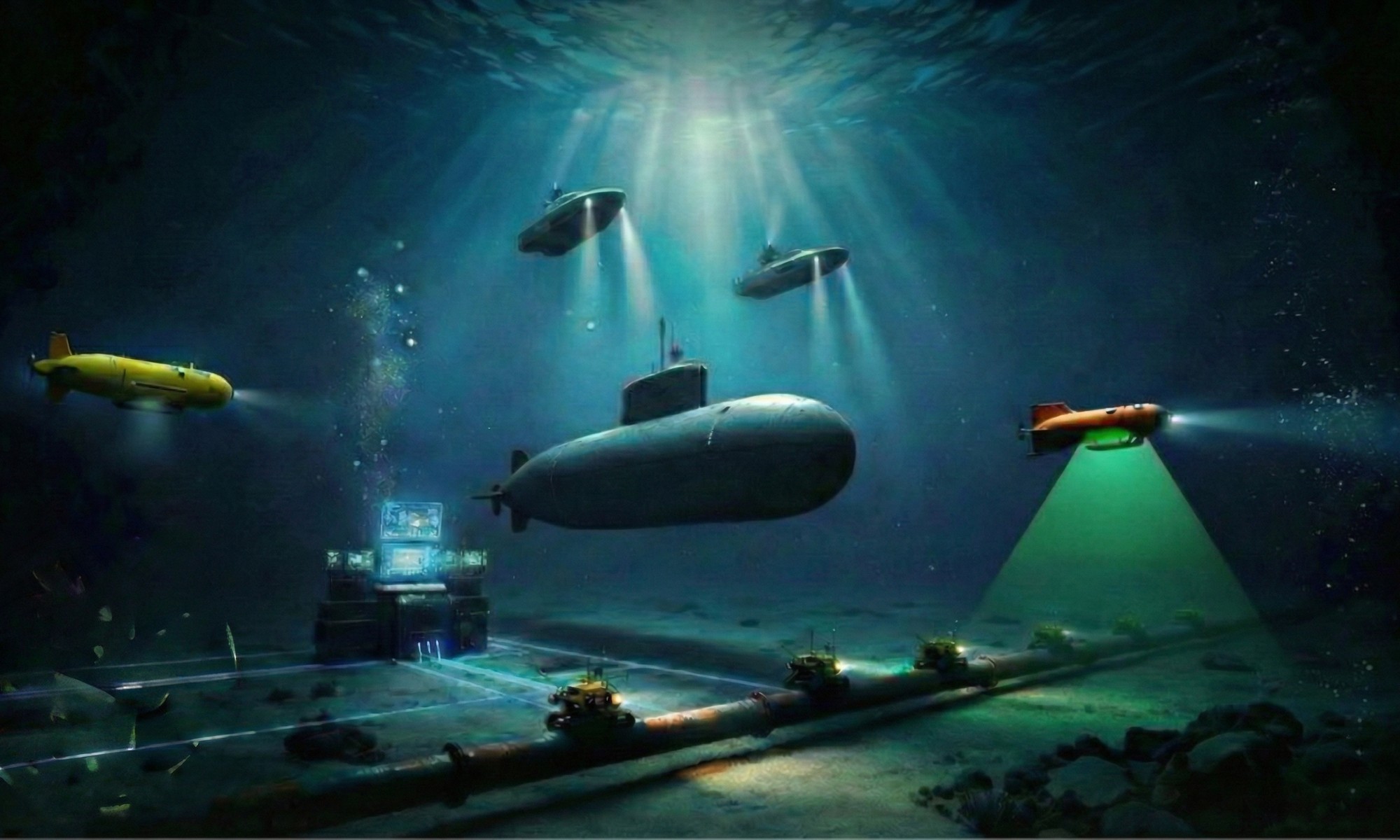
Intruder Detection Systems: Why Reaction Time Is the Real Vulnerability

1. The Underwater Perimeter Has Moved

The waterline is no longer the boundary of maritime security. That line has sunk below the surface, into a domain that is opaque, cluttered, and unforgiving of delay.

Ports, naval bases, offshore energy assets, pipelines, and subsea infrastructure are now threatened primarily from below. Dive Detection Systems (DDS) have therefore become foundational elements of maritime protection architectures.

It is all about reaction time

Yet despite significant advances in sonar performance, classification algorithms, and autonomy, most underwater security failures still stem from the same root cause:

Reaction time.

Detection alone does not stop an intrusion. Detection without timely action merely records it.

2. The Threat Has Changed Faster Than the Response Model

Historically, the underwater threat was human and constrained. Open-circuit divers produced bubble trails. Endurance was limited. Approaches were slow and predictable.

That era is over.

Today’s threat landscape includes:

  • Closed-circuit rebreather divers with no visible bubble signature
  • Widely available high-end commercial dive equipment
  • Unmanned Underwater Vehicles (UUVs) with long endurance and zero risk to the operator

Complicating matters further, ambiguity is now routine. A sonar contact may be a saboteur, a recreational diver, or a survey drone. The sensor does not know. The command chain must decide.

And every second spent deciding compresses the remaining response window.

3. Detection Is a Solved Problem. Reaction Is Not.

Modern DDS sensors can detect small, slow targets in noisy, cluttered environments. The technical challenge of “seeing” underwater has largely been addressed, even if there are still issues with “false alarms”.

The operational challenge has not.

A credible dive detection architecture must support the full chain:

  • Early detection
  • Rapid classification
  • Low-latency alerting
  • Immediate, actionable response

If any part of that chain relies on slow human mobilization, the system fails operationally — even if it performs perfectly on paper.

4. Key Detection Systems and Their Strategic Roles

Forcys Sentinel

Forcys Sentinel is designed for long-range early warning. Its strength lies in coverage and standoff distance, detecting divers at significant ranges and UUVs even farther. There is also an interesting passive mode.

Strategically, Forcys Sentinel buys time. That time is critical for cueing mobile assets and initiating autonomous response actions before the intruder reaches the asset of interest. Sentinel performs best as the outer layer in a layered defense architecture.

DSIT AquaShield

AquaShield focuses on autonomy and discrimination. Advanced signal processing and adaptive thresholding reduce false alarms in busy harbors, which is operationally vital.

False alarms consume attention, degrade trust, and slow reaction. By delivering higher-confidence alerts, AquaShield accelerates decision-making and supports rapid escalation when required. Its hardened design also reflects an assumption that sensors themselves may be targeted.

SDIT also has the PointShield, a smaller portable sonar system.

Norbit GuardPoint

GuardPoint systems are optimized for persistent, fixed monitoring of critical infrastructure. Their value lies in continuous availability and reliability in known geometries such as ports and terminals.

As with all fixed systems, GuardPoint’s effectiveness depends on how quickly a response asset can be cued and dispatched. Integrated properly, it becomes a reliable sentry rather than a passive observer.

Norbit has several different sonar systems for intruder detection, all of which are named GuardPoint.

Artist illustration of different sonar systems

5. Why Human-Centric Response Fails

The moment an intruder is detected, the clock starts.

Traditional response concepts assume:

  • An operator raises an alarm
  • Personnel are notified and mobilized
  • A patrol boat is crewed, started, and deployed
  • The boat transits to the contact location

This sequence may take 20 to 60 minutes — sometimes longer.

For underwater intrusions, that is an eternity.

By the time a crewed vessel reaches the scene, the diver has exited, the UUV has completed its task, and the opportunity to act is gone.

This is why humans cannot be the first responders.

6. Automating the Response Loop

The only viable response model is a machine-speed reaction layer, centered on unmanned surface vehicles (USVs).

In this architecture, humans remain in command — but not in the pursuit loop.

The Operational Flow

Detection — A fixed or mobile DDS detects and tracks a subsurface contact.

Immediate Autonomous Dispatch — A pre-positioned USV is activated instantly. No crew. No delay.

Re-Detection and Close Classification — The USV intercepts the target and re-detects it using high-resolution, motion-stabilized sonar, maintaining continuous track despite sea state and maneuvering.

Evidence, Not Assumptions — The USV transmits sonar imagery, tracks, and behavioral data to the Commanding Officer via secure data link.

Command Decision at the Right Level — The CO receives verified classification, not raw alarms, and authorizes action while the intruder is still present.

This model preserves command authority while eliminating fatal latency.

7. Neutralization Options: Speed with Control

Once classification is confirmed, response options must already be integrated with the USV.

Typical actions include:

Physical Capture — Net systems launched from the USV to entangle divers or disable UUV propulsion. Clean, non-lethal, and legally straightforward.

Acoustic Disruption — Directional acoustic devices, including airgun-based systems, that create localized shock, vibration, or disorientation to deny mission completion.

Critically, these actions are executed from the unmanned platform, not after human arrival. The CO authorizes. The system acts.

8. The Strategic Takeaway

Dive detection is no longer a sonar problem. It is a time management problem.

The systems that matter are not those with the longest range or smallest detectable target, but those that compress the timeline from first acoustic return to decisive action.

If your response depends on waking people up, starting engines, and driving to the scene, you are already too late.

Underwater security is won by closing the loop, autonomously, quickly, and with command authority applied at the right moment.

In the subsea domain, reaction time is the weapon. Everything else is instrumentation.

Call-To-Action

Please provide comments and challenge me. We all need to discuss to learn more from each other.


Originally published in the Strategic Pings ))) newsletter on LinkedIn on 2026-02-02. Subscribe there to get new editions first.

Strategic Pings: Why Forward-Looking Sonar Is a Non-Negotiable for Modern USVs

Introduction: The Sensor That Saves You Before You Realize You Needed Saving

Everyone loves the glamorous sensors on a USV. Radar provides long-range detection capabilities. Lidar with Hollywood laser precision. Cameras that could film a documentary about seagulls. Multibeam sonar maps the seafloor with centimeter-level resolution.

And then there is the Forward-Looking Sonar (FLS). Quiet. Underrated. Sitting low below the bow like a hardworking intern who prevents the company from collapsing every Friday afternoon.

Forward Looking Sonar Applications

It may not get the marketing spotlight. But it is the one sensor that keeps the USV from becoming a very expensive hood ornament on a hidden rock.

Let us talk about why.

The Blind Spot That Refuses To Go Away

USVs now operate in places where charts are unreliable. Many are old. Some are missing data. Some are works of fiction.

Downward echo sounders only report where you already were. Surface sensors cannot see below the waterline. Autonomous systems require accurate, real-time data to operate effectively.

This creates a single dangerous gap:

The underwater domain directly ahead of the bow.

That is where you find:

  • Uncharted hazards
  • Rocky pinnacles
  • Coral heads
  • Submerged debris
  • Hidden ice
  • Containers drifting just below the surface

Without forward-looking sonar, the USV is effectively blind underwater. Not ideal when you want the platform to survive the mission.

I’ve seen several times USVs crashing into underwater obstacles, the latest at Taskforce X in Finland, when one USV crashed so hard that it almost sank.

AI Illustration of USV

Why Forward-Looking Sonar Matters

2D forward-looking sonar can detect objects ahead, but does not provide depth information. The result is often ambiguous, making it difficult to assess the situation.

Operators or autonomous systems cannot determine whether the object is:

  • Deep and safe
  • Or shallow and destructive

Modern forward-looking sonar, including 3D models, provides a comprehensive underwater view with range, bearing, and depth information. This transforms sonar data into actionable insights.

This enables confident and reliable navigation.

Application 1: Real Obstacle Avoidance Below the Surface

Forward-looking sonar complements the other sensors, such as radar, cameras, and Lidar, which monitor the surface. Together, they provide comprehensive situational awareness.

FLS detects:

  • Reefs and shoals
  • Coral formation
  • Ice features
  • Marine mammals
  • Lost shipping containers
  • Old infrastructure
  • Rapid seabed changes

This information feeds directly into the autonomy engine. The USV reacts in real time. It adjusts course. It avoids the hazard. It enables the USV to complete its mission efficiently and safely.

This capability is essential for mission assurance.

Application 2: Tactical Survey and Rapid Environmental Assessment

Forward-looking sonar (FLS) is not designed for detailed hydrography like multibeam systems. Its primary strengths are speed and situational awareness.

When seabed conditions change unexpectedly, FLS provides the fastest means to obtain an updated underwater view.

It supports operations such as:

  • Natural disaster response
  • Rapid environmental assessment
  • Safe passage planning after storms
  • Quick checks before sending in AUVs or divers

The USV gathers usable data on the move. Operators immediately see what changed. Survey teams know where to focus the high-resolution MBES lines.

This shortens timelines. Reduces uncertainty. It also eliminates unnecessary survey routes.

This enables tactical surveys to be conducted at operational speed.

Application 3: An Essential Enabler for Mine Countermeasures (MCM)

Mine countermeasures is a field where “do not hit anything” becomes an official strategy.

Forward-looking sonar supports MCM operations by:

  • Revealing underwater structures near the USV
  • Showing rapid bathymetric changes
  • Helping maintain stand-off from threats
  • Protecting the platform during maneuvers

The MCM payload may do the heavy classification work. However, FLS ensures the USV remains operational long enough to deploy these systems.

It serves as a critical safety layer, preventing the USV from triggering mines.

Application 4: Daily Navigation in Unpredictable Waters

Ports change. Rivers shift. Tropical channels grow new sandbars every week. Ice forms underwater ledges that can break a hull. Offshore wind farms hide half-built subsea structures.

Forward-looking sonar gives immediate underwater awareness in these dynamic environments.

It helps the USV:

  • Detect changes since the last mission
  • Navigate near infrastructure
  • Avoid submerged work platforms
  • Stay safe in shallow and shifting waters

Routine navigation becomes more effective. It is also more predictable. And far safer for an unmanned asset.

Example of Systems

The graph below shows an example of forward-looking sonar systems.

Example of FLS Sonar Systems

Norbit FLS Sonar: A compact and advanced forward-looking 2D sonar. I see this as the baseline FLS and fulfill 80% of all requirements for any USV. It is easy to install and operate, and can function as a dual-head with the Norbit MBES series, offering significant integration advantages in smaller USVs for hydrographic applications.

Farsounder Argos 3D Sonar: This system provides 3D mapping capabilities and can be integrated into various bridge systems. The system can also interface to QPS software.

Wavefront 3D Sonar: This high-end 3D sonar offers higher resolution and improved performance, though it is significantly more expensive.

Conclusion: The Three Things That Matter Most

If you take away three key points, they are:

The underwater blind spot is the most dangerous threat to a USV. Charts and surface sensors cannot fix it.

Forward-looking sonar is the only sensor that gives real-time underwater awareness. It closes the one gap that autonomy cannot guess through.

It enables critical applications such as obstacle avoidance, tactical surveys, rapid environmental assessment, safer mine countermeasures, and improved navigation in challenging waters.

Forward-looking sonar may never get the glamour slots at conferences. But it is the sensor that prevents the headlines nobody wants.

This is why Forward-Looking Sonar is nonnegotiable for USV operations

Call To Action

Please comment and provide feedback so we all can learn from each other


Originally published in the Strategic Pings ))) newsletter on LinkedIn on 2026-01-27. Subscribe there to get new editions first.

From Surface Watchkeeper to Underwater Hunter: How USVs Are Reshaping ISR and ASW

Unmanned Surface Vehicles (USVs) are well established in hydrography and mine countermeasures. However, their most significant impact is now emerging in Intelligence, Surveillance, Reconnaissance (ISR) and Anti-Submarine Warfare (ASW).

I’m a strong believer in integrated ISR with Passive ASW, and as a former submariner (bubblehead), I believe they complement each other.

These missions involve challenging detection, strict timelines, and strategic consequences for errors. In this context, one principle remains:

A USV is not the capability. A USV enables the capability.

The true value lies in the payload, sensor integration, and the ability to convert raw data into actionable intelligence.

ISR Is No Longer About Sensors. It’s About Understanding.

Modern ISR-configured USVs serve as autonomous watchstanders. They operate continuously and do not miss radar sweeps.

The sensor suites are familiar: maritime surveillance radar, long-range EO/IR, AIS, electromagnetic sensors, and increasingly, passive acoustics. None of these are revolutionary on their own.

The transformation comes from how these sensors are integrated.

Radar establishes presence at range. EO/IR confirms identity. AIS either validates intent or exposes deception. EM sensors reveal electronic behavior invisible to the eye. Autonomy engines analyze patterns, correlate domains, and predict behavior.

Operators no longer monitor disconnected feeds; instead, they receive a coherent maritime picture.

USV for ISR and Passive ASW

This distinction is important. In gray-zone environments, where ambiguity is used as a tactic, early recognition of intent is often more decisive than firepower.

The modern EW and SIGINT landscape is being shaped by the strategic convergence of several interdependent technological trends. The integration of Artificial Intelligence (AI) and machine learning onto unmanned platforms—across air, sea, and land domains—is enabling autonomous sensor grids to operate at the tactical edge without constant human oversight.

These distributed networks of assets extend the reconnaissance horizon and reduce risk to personnel by removing the human operator from the immediate tactical environment. Concurrently, an industry-wide shift toward modular, open-architecture systems is the critical enabler for this evolution. This “future-friendly” design philosophy allows for the rapid integration of new AI algorithms and diverse sensor payloads onto unmanned platforms, ensuring that forces can adapt faster than their adversaries. Together, these trends are creating a more distributed, resilient, and lethal force, capable of processing vast amounts of intelligence data at machine speed to accelerate decision-making and stay ahead of emerging threats.

Prominent manufacturers are Northrup-Grumman, HENSOLDT, Rafael, L3Harris, and Teledyne.

ASW: Where USVs Deliver Disproportionate Advantage

While ISR is complex, ASW is even more demanding. It remains the most challenging mission in maritime warfare and is increasingly costly to sustain with only manned platforms.

Traditional ASW relies on frigates, maritime patrol aircraft, and helicopters. While these platforms are highly capable, they are limited by cost, crew requirements, and endurance.

USVs change this dynamic.

A well-designed USV can tow a passive array at four to six knots for extended periods, operating quietly and persistently without risking personnel. With modern onboard acoustic processing, including broadband, LOFAR, DEMON, and environmental modelling, even medium-sized USVs can detect, classify, and track targets.

This capability is operational, not experimental, and provides significant leverage.

Ultra-low radiated noise makes USVs effective passive sensors. Their long endurance allows for continuous patrols. Low-probability-of-intercept communications maintain stealth, while autonomous behaviors ensure contact geometry and track continuity.

When deployed in numbers, USVs form mobile acoustic pickets, extending ASW coverage well beyond the limits of manned forces.

Passive Towed Arrays, utilized by both submarines and surface combatants, are substantial in length, up to 150-2000 meters aperture, which require larger winch systems, not feasible on medium-sized USVs.

For USVs, the typical aperture length will be 25–150 meters, due to the size and weight of winch equipment.

Prominent manufacturers are L3Harris, THALES, ATLAS, SEA, Sensor Technologies, Raytheon, and Kongsberg

Integration Is the Capability

As with hydrography and mine warfare, the hull itself is secondary. In ISR and ASW, integration is everything.

Precision navigation and motion reference underpin acoustic performance.

Secure, resilient communications, LOS, SATCOM, mesh, move intelligence where it matters.

Edge computing enables real-time processing, reducing latency and bandwidth demand.

Autonomy manages execution: patrol adaptation, contact following, dynamic re-tasking. Humans remain firmly in the loop, supervising intent and authorizing decisions—but they are no longer burdened by mechanical control.

This is why leading USVs should not be viewed as “remote boats.” They are autonomous intelligence nodes, designed to operate as part of a wider maritime sensing architecture.

How These Systems Are Being Used Today

Globally, ISR USVs conduct persistent patrols along EEZ boundaries, monitor smuggling routes, and identify dark shipping by fusing AIS, radar, and EO/IR data.

Ports and coastal authorities use USVs to track small craft, monitor choke points, and correlate surface activity with acoustic and electromagnetic signatures.

In ASW, multiple USVs with towed arrays are deployed as acoustic barriers, coordinated with AUVs and sonobuoys in multi-static configurations. Contacts are continuously maintained and transferred to manned assets as needed.

For covert ISR, low-signature USVs conduct discreet patrols, collect imagery, and passively monitor RF and EM activity without revealing their presence.

No crewed vessel can match this combination of persistence, discretion, and cost efficiency.

The Strategic Shift: From Missions to Presence

ISR and ASW are shifting from platform-centric activities to distributed, networked sensing challenges.

USVs are well suited to this model. They offer persistent presence, stealthy acoustic profiles, real-time data fusion, and, importantly, scalability.

They enable navies to transition from episodic deployments to continuous operations.

This is the true strategic advantage.

Final Thought

USVs are not replacing frigates, maritime patrol aircraft, or submarines. Instead, they enhance these platforms by extending sensor reach, persistence, and situational awareness across the battlespace.

A USV without integrated sensors is simply a boat. A USV equipped with radar, EO/IR, AIS, electromagnetic sensors, and a passive towed array becomes a valuable ISR and ASW asset.

USVs and Maritime Security

The direction is clear.

The future of maritime security will be unmanned, integrated, networked, and persistent, with USVs at the center of this transformation.

Call-To-Action

Please comment and provide your ideas, so we can learn from each other.


Originally published in the Strategic Pings ))) newsletter on LinkedIn on 2026-01-20. Subscribe there to get new editions first.

Sonar 76Nano: When Seabed Warfare Goes Small, Smart, and Autonomous

After being in the sonar design business for over 30 years, there are not many things that get me excited. But this Nano76 is an exception, I got really excited when I was reading about this development. I couldn’t find much, so I decided to collect all available information and present it in one of my Newsletters. This is based on open public information, so it may not be 100% correct.

Big shifts in naval warfare rarely arrive with fanfare. They arrive quietly. Smaller. Lighter. Smarter.

And then, a few years later, everyone wonders how they ever operated without them.

Thales’ recent unveiling of the Sonar 76Nano belongs squarely in that category.

At first glance, it looks like a classic case of miniaturization. In reality, it is something far more disruptive.

It is a strategic payload designed for a world where seabed warfare, autonomous systems, and persistent underwater surveillance are no longer optional.

They are the baseline.

From Flagships to Tiles

The Sonar 76Nano is not an incremental upgrade. It is a philosophical shift.

Thales has taken the DNA of its flagship Sonar 2076, the system that sits at the heart of the Royal Navy’s most capable submarines, and compressed it into modular tiles measuring roughly 75 by 75 centimeters.

My illustration of Nano76

This development is significant.

When high-end sonar is no longer limited to nuclear submarines and large frigates, the balance of power beneath the sea shifts fundamentally.

Advanced acoustic sensing is no longer limited to:

  • Billion-dollar platforms
  • Limited fleet numbers
  • Crewed assets with political risk attached

Instead, it can be deployed on UUVs, seabed nodes, and autonomous systems designed for quiet, long-term operation.

That is the real breakthrough.

Why This Happened So Fast

This prototype did not take a decade. It took ten months.

Thales invested over £2 million of its own funding to make it happen. That alone tells you something important.

This was not a technology-push project. It was a strategic response.

The subsurface domain is heating up. Fast.

Russian submarine activity around the UK has increased sharply. Chinese survey vessels are mapping seabeds across the Indian Ocean. Undersea cables and pipelines are no longer abstract infrastructure. They are targets.

At the same time, Western navies are operating fewer hulls. Fewer submarines. Fewer frigates.

But the ocean did not get any smaller.

That gap between demand and force structure is exactly where autonomous systems move from “interesting” to “essential”.

Autonomy Needs Real Sensors

There is an uncomfortable truth about autonomous platforms.

Autonomy without sensing is just expensive drift.

Autonomy needs real sensors

What makes the Sonar 76Nano important is not that it is autonomous-friendly. It is that it brings real acoustic capability to platforms that previously carried compromise sensors.

Active and passive modes matter here.

In passive mode, a UUV becomes a quiet listener. Persistent. Patient. Hard to detect.

In active mode, with low-probability-of-intercept signaling, it becomes something more interesting.

A node.

Not just a sensor, but part of a submerged network.

This is how underwater mesh networks start to look operational rather than academic. Vehicles that detect, classify, share, and cue without surfacing or calling home every five minutes.

That is a very different game.

Seabed Warfare Is No Longer Theoretical

For years, seabed warfare lived mostly in conference slides. That phase is over.

Cables have been cut. Pipelines have been sabotaged. Survey vessels are no longer assumed to be benign.

The Sonar 76Nano is clearly designed with this reality in mind.

Its integrated synthetic aperture sonar provides long-range, high-resolution seabed imaging that does not degrade with distance. That is exactly what you want when inspecting cables, pipelines, or suspicious seabed activity at speed.

More importantly, it enables persistence.

A UUV does not need a crew rotation. A seabed node does not need coffee.

It just listens. And watches.

The Real Power Is the Network

No modern sonar operates alone. And the 76Nano is very much a digital-native system.

Designed from the outset to plug into UK and NATO architectures, it feeds into a larger picture rather than creating yet another stovepipe.

That matters operationally.

Data from autonomous platforms only becomes strategic when it fuses with:

  • Towed arrays
  • Dipping sonars
  • Fixed seabed sensors
  • Intelligence feeds

This is how navies move from individual detections to what commanders actually want. A recognized persisitant underwater picture.

Or, put more bluntly. Who is down there. Where. And what they are doing.

Three Strategic Takeaways

If you zoom out, the Sonar 76Nano points to three very clear shifts.

Undersea Warfare Transformation

First: High-end ASW is no longer exclusive Miniaturized, high-performance sonar breaks the monopoly of large, crewed platforms. That changes deterrence math. For everyone.

Second: The hybrid fleet is now unavoidable Crewed platforms orchestrating autonomous sensors is no longer a concept. It is becoming doctrine.

Third: Seabed security moves from reactive to persistent You cannot protect what you only inspect after something breaks. Persistent sensing changes the timeline. And the outcome.

Final Ping

The Sonar 76Nano is not just a smaller sonar.

It is a strategic enabler for how navies will think about underwater presence, risk, and control over the next decade.

Less about platforms. More about payloads. Less about episodic patrols. More about continuous awareness.

In seabed warfare, size still matters.

Just not in the way it used to…

Call To Actions

Please follow me to get my newsletters, every week. Comment and create discussions so we can all learn from each other. If you have any requests for newsletters, let me know and I see what I can do.

Future newsletters will include ASW with Unmanned Systems, Intruder Detection Systems and much more.


Originally published in the Strategic Pings ))) newsletter on LinkedIn on 2026-01-13. Subscribe there to get new editions first.

The Synthetic Aperture Sonar Revolution in Modern Mine Countermeasures

In mine warfare, technology rarely evolves in neat increments. It tends to leap, driven by necessity, shaped by adversary innovation, and validated only at sea. Today, Mine Countermeasures (MCM) finds itself in the middle of such a leap. The proliferation of stealthy, low-target-strength sea mines has fundamentally shifted the operational center of gravity, from detection to classification.

Finding objects on the seabed is no longer the hard part. Modern sonars are exquisitely sensitive. The real challenge is determining, with speed and confidence, whether a contact is a mine or just another piece of seabed clutter. In congested littoral waters, this distinction is the difference between operational momentum and paralysis.

Classification Is the New Battlespace

Modern sonar systems are designed to detect faint acoustic returns. Inevitably, this sensitivity produces a flood of detections. Natural rocks, discarded debris, and seabed features all generate returns that initially appear suspicious. At first pass, these are flagged as Mine-Like Echoes (MILECs). Only after detailed analysis can they be refined into Mine-Like Contacts (MILCOs) worthy of further action.

Data Superiority
Data Superiority

As detection performance improves, the number of MILECs grows exponentially. The burden shifts downstream, onto classification. This is where the “ambiguity factor” becomes decisive—the proportion of benign objects that look statistically similar to real mines. A high ambiguity factor translates directly into wasted sorties, delayed clearance, and increased risk. Reducing it is now the primary operational objective in MCM.

The most effective way to do so is straightforward in concept, if complex in execution: deliver higher-resolution imagery, from multiple perspectives, at operationally relevant ranges. This is precisely where Synthetic Aperture Sonar (SAS) has become indispensable.

Why Synthetic Aperture Sonar Changes the Game

Traditional Side Scan Sonar remains limited by physics. Along-track resolution degrades with range, forcing an uncomfortable trade-off between coverage and clarity. Wide-area surveys produce imagery that is often insufficient for confident classification of modern, low-observable mines. If you look at Klein 5000 and 5900, they are still performing well, but not as well as SAS sonars.

SAS breaks this constraint. By coherently combining successive acoustic pings along a precisely tracked trajectory, SAS synthesizes a long virtual array. The result is range-independent, centimeter-scale resolution across the entire swath. For MCM commanders, this means wide-area coverage without sacrificing image fidelity—an essential capability when time and certainty are equally critical.

Conventional SSS vs SAS Sonar

This leap has catalyzed a new generation of highly specialized systems, each optimized for different points in the MCM kill chain.

Four Philosophies, One Objective

The four different companies and SAS sonar described below share some similarities but differ in their design philosophies.

Pictures of different SAS sonars. Top Left: Kraken, Top Right: EXAIL, Lower Left: Northrup Grumman, Lower Right: THALES

Thales – SAMDIS The SAMDIS system is engineered around classification confidence. Its defining feature is multi-aspect imaging, capturing three distinct views of each contact in a single pass and generating six high-resolution SAS images. This approach directly addresses shadow ambiguity, one of the most persistent sources of false alarms. Integrated into the Franco-British MMCM program, SAMDIS emphasizes probability over pace, delivering classification confidence exceeding 95% in cluttered environments.

Exail – UMISAS UMISAS reflects a systems-integration philosophy. By combining ultra-high-resolution SAS imagery with co-registered interferometric bathymetry, it produces a precise geometric model of the seabed. Its autonomous, self-powered T18-M towed body minimizes drag and enables high-speed operations from both crewed vessels and Unmanned Surface Vessels. The result is a tightly integrated sensor-platform ecosystem optimized for robotic MCM operations.

Northrop Grumman – AN/AQS-24 Speed defines the AQS-24. Designed to clear lanes and map threat environments rapidly, it couples high-speed SAS with an integrated Laser Line Scanner. This hybrid architecture enables detection, classification, and optical identification in a single sortie. By collapsing the traditional “detect–classify–identify” sequence, the system delivers a powerful operational advantage when time is the dominant constraint.

Kraken Robotics – KatFish KatFish approaches the problem from a platform-stability perspective. Its actively stabilized towfish uses articulated control surfaces to physically counteract motion, ensuring the coherent data quality SAS demands. Combined with a nadir gap-filler (Norbit MBES) and wide swath, this enables exceptional area coverage rates without sacrificing resolution. The emphasis here is efficiency—maximizing high-quality data collected per hour at sea.

Comparison

Comparison of SAS sonars (Note: this is based on open information and may not reflect the latest features)

Choosing Where to Win

There is no universally “best” SAS system. Each excels at a different point in the MCM kill chain. High-speed detection favors systems like the AQS-24. Dense, cluttered seabeds reward multi-aspect classification approaches such as SAMDIS. Persistent, wide-area mapping benefits from stabilized, high-coverage solutions like KatFish. Integrated robotic fleets align naturally with UMISAS.

Illustration of SAS sonar Towed Bodies

What matters is the alignment between strategy and sensor philosophy.

My personal view:

  • THALES multi-view is the next generation SAS and, in my mind, superior, especially for classification. However, it is costly.
  • If you need to go very high-speed, you need the Northrup-Grumman AQS-24.
  • The EXAIL is more focused on AUV than towed systems.
  • The Kraken KatFish is the most budget-friendly, with excellent performance.

A Data-Driven Future Beneath the Keel

Mine countermeasures are moving inexorably toward autonomous, data-centric operations. Synthetic Aperture Sonar is the enabling sensor at the heart of this transformation, providing the resolution, consistency, and confidence modern mine warfare demands. As competition accelerates and systems mature, the real advantage will belong to navies that understand not just what these sensors can do, but where, when, and why to deploy them.

In modern MCM, clarity is currency. SAS is how it is earned

Call to Action

Please subscribe to my newsletter, share, and comment. That is the best way to create a dialogue so that we can all learn from each other.


Originally published in the Strategic Pings ))) newsletter on LinkedIn on 2026-01-06. Subscribe there to get new editions first.

The Future of Mine Warfare Is Uncrewed, Autonomous, and Sensor-Led

Mine Countermeasures (MCM) is entering a new era—one defined not by manned minehunters or clearance divers, but by autonomous sensor systems that keep sailors safely out of the minefield. Against a backdrop of rising geopolitical tension and repeated incidents involving subsea pipelines and communication cables, nations are embracing stand-off, unmanned MCM concepts at unprecedented speed.

Why the USV Matters, But Is Not the Capability

New Mine Counter Measure Concept based on USVs

In this emerging operational model, the USV becomes the vehicle that carries the sensor suite, but not the sensor suite itself. This distinction is far more than academic—it is strategic.

Mines do not react to the design of the vessel. They react to proximity.

Removing humans from that proximity fundamentally reshapes the risk equation of mine warfare. Instead of sending a crewed minehunter into a suspected minefield, commanders now deploy an unmanned surface vehicle towing a sophisticated sonar package, operating autonomously, and maintaining precise navigation without exposing personnel to danger.

The USV provides the platform—speed, towing geometry, stability, and endurance. But the capability is the integrated sensor chain and autonomy stack.

The Modern MCM Mission Chain: Detect, Classify, Neutralize

MCM Flow
MCM Flow

The effectiveness of any MCM system depends entirely on the performance of its sensors and data-processing ecosystem.

1. Detection: Seeing the Seafloor in Centimeters

Modern detection relies on:

  • High-frequency multibeam echosounders (MBES) to create a topography baseline
  • Synthetic Aperture Sonar (SAS) delivering ultra-sharp seabed imagery (main sensor)
  • High-SNR acoustic returns for cluttered environments
  • Wide-area high-coverage geometries enabled by towed bodies or AUVs

Only centimeter-level imagery provides the confidence required to separate a mine from a rock, crate, anchor, or biological clutter.

2. Classification: Turning Raw Data Into Decisions

Classification now depends on:

  • Machine learning
  • Automatic Target Recognition (ATR)
  • On-board and off-board processing pipelines
  • Robust, low-noise navigation
  • High-fidelity metadata and positioning

The shift toward AI-assisted classification dramatically reduces post-mission analysis time and increases throughput—critical in large minefields.

3. Neutralization: Precision Intervention

Once a contact is declared a mine-like object, neutralization requires:

  • Precise localization
  • Stable hover capability
  • Deployment of expendables or ROV-based charges
  • Autonomous reacquisition of the target

ROVs remain a critical component of the final step—machines dealing with the threat, humans commanding at a distance.

USVs as Host Platforms: The Global Shift

This operational logic is evident across major international MCM programmes. Consider:

  • Textron’s UISS: A USV towing advanced minehunting sensors as part of the U.S. Navy’s LCS MCM mission package.
  • Exail’s Inspector series: A modular platform capable of SAS towing, AUV launch, and multi-sensor operations.
  • Thales/Royal Navy autonomous MCM trials: Demonstrating a scalable, distributed, unmanned delivery model.
  • Belgium-Netherlands rMCM programme: Entirely built on the concept of unmanned off-board systems.

Across these programs, one consistent truth emerges: The boat is a host. The sensors are the capability. Autonomy is the glue that binds them together.

The Rise of Autonomy in MCM

Early USVs relied heavily on remote control. But autonomy is now evolving into a decisive operational advantage.

Human-in-the-loop → Human-on-the-loop — The system executes pre-defined patterns while an operator supervises rather than commands continuously.

Real-time autonomy decisions — The USV adjusts line spacing, towing behavior, or avoidance patterns based on conditions.

Intent-based autonomy (emerging) — An operator defines the outcome (“Search this area to STANAG confidence level”), and the USV decides how to execute—tow speed, pattern, sensor configuration, revisit logic.

This reduces workload, increases tempo, and standardizes mission execution across theatres and operators.

Why This Transformation Matters Strategically

The stakes have never been higher. Seabed infrastructure—pipelines, interconnectors, offshore wind farms, energy lines, and the fiber-optic cables carrying 97% of global internet traffic—has become a prime target for hybrid operations and grey-zone sabotage.

Autonomous MCM systems offer:

  • Persistent presence without risk to personnel
  • Scalable coverage across vast areas
  • Lower cost per mission than traditional minehunters
  • Distributed architectures resilient to attrition
  • Rapid deployment in contested or denied environments

In the emerging underwater battlespace, autonomy and sensors—not hulls—define superiority.

The End of the Legacy Minehunter Era

For a century, sailors entered the minefield. Now, machines do.

The shift is irreversible. Modern navies will be defined not by the number of minehunters in service, but by their ability to deploy autonomous, sensor-driven MCM systems that find, classify, and neutralize threats at standoff distance.

In the new era of mine warfare, the vessels are unmanned, the sensing is autonomous, and the decisions remain human.

CLOSING THOUGHT

Modern MCM USVs mark the end of a 100-year paradigm

Sensors do the work

Autonomy handles the danger

Humans make the decisions

CTA (Call to Subscribe / Call to Action)

If you want more insights into autonomous systems, sonar technology, seabed security, and how modern navies are redefining MCM doctrine, subscribe to STRATEGIC PING, my LinkedIn newsletter on sonar technology, maritime autonomy and underwater warfare.

The next newsletter will focus on which sonar systems these MCM platforms use, so a comparison of SAS sonars, Kraken, THALES, EXAIL, and Northrup Grumman. Stay ahead of the curve. Stay informed and be part of the conversation.


Originally published in the Strategic Pings ))) newsletter on LinkedIn on 2025-12-29. Subscribe there to get new editions first.