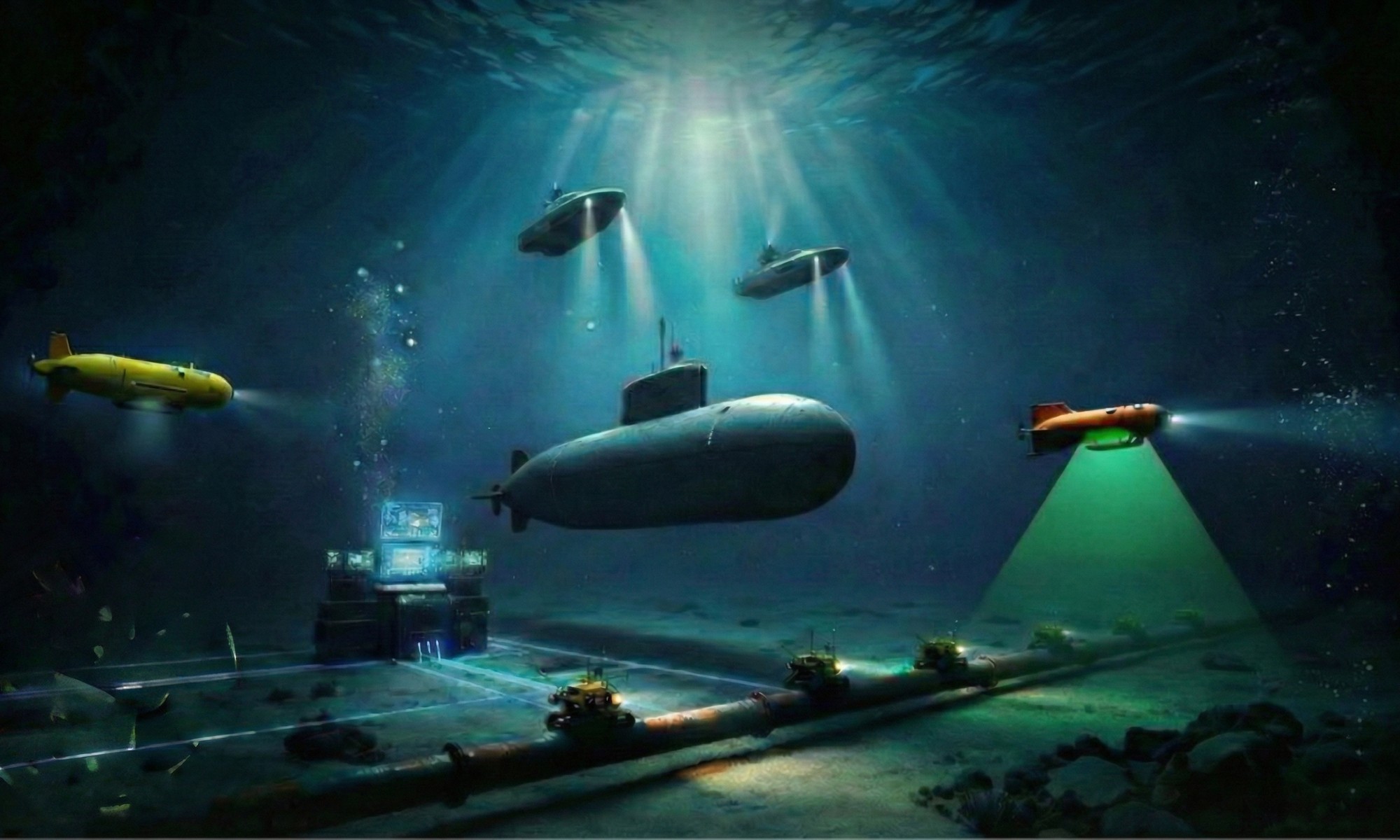

How USV–AUV Mothership Operations Are Redefining Protection of Critical Underwater Infrastructure
Critical Underwater Infrastructure (CUI), subsea pipelines, power cables, and global communications links form the invisible foundation of modern society. These assets that carry energy, data, and provide economic stability across oceans are quietly enabling everything from national defense to daily digital life, whilst also becoming increasingly vulnerable.
The sabotage of the Nord Stream pipelines in 2022 and the damage to the Baltic pipeline in 2023 did more than disrupt energy flows. These incidents revealed that much of the critical seabed infrastructure remains unprotected, insufficiently monitored, and difficult to defend via traditional maritime surveillance.
What makes the challenge even more complex is the nature of the threat. Many hostile actions targeting CUI fall into the “grey zone”. Though deliberate and deniable, they’re intended to avert escalation whilst still achieving strategic effects. Attribution is difficult, deterrence even harder, and episodic monitoring is no longer enough. Protecting CUI now requires persistent, high-resolution, and cost-effective underwater surveillance on a continuous basis.
Why Traditional Surveillance Models Fall Short
Established approaches to subsea monitoring struggle to meet this requirement. Fixed seabed systems, such as hydrophone arrays, provide persistent monitoring but only at known locations. Once identified, they can be avoided, spoofed, or neutralised. Their static nature is both an advantage and a limitation.
Crewed vessels deliver mobility, but at a prohibitive cost. Daily operating expenses routinely exceed tens or hundreds of thousands of dollars. Their acoustic and visual signatures are unmistakable, making discreet monitoring impossible. Most critically, launching and recovering underwater systems in real sea states exposes crews and equipment to considerable risk.
Standalone AUV operations solve some problems, but cause another: endurance. Battery limitations typically restrict missions to less than 24 hours. When depleted, the AUV must be recovered, recharged, and redeployed. The result is a stop-start surveillance model, punctuated by gaps precisely when persistence matters most.
In short, today’s tools were never designed for continuous, wide-area CUI protection.
The Shift: USVs as Motherships, AUVs as Persistent Sensors
A new operational model is emerging that fundamentally changes how subsea infrastructure can be protected.
At its core is a symbiotic USV–AUV concept: Unmanned Surface Vehicles acting as autonomous motherships, supporting and sustaining fleets of Autonomous Underwater Vehicles.
This does not concern replacing ships with drones. It is about breaking the endurance barrier and creating a system where at least one AUV is always in the water – surveying, mapping, and monitoring critical infrastructure – while others recharge, upload data, or stand by. Persistence becomes the standard, not the exception.
The Operational Principle: Continuous AUV Rotation
The model is simple yet operationally effective. A USV deploys a fully charged AUV to survey a defined CUI corridor. As that AUV approaches its battery or mission limit, it autonomously returns to the USV. A launch-and-recovery system (LARS) enables safe, automated docking, often without the AUV even leaving the water. While the returning vehicle recharges and offloads data, a second AUV is deployed immediately.
The result is a continuous rotation cycle: 1 – one AUV surveying; 2 – one AUV charging; 3 – one AUV processing or standing by. There are no surveillance gaps, no need for crewed recovery, and no dependence on weather windows to dictate operational tempo. This capability establishes the USV as an effective force-multiplying mothership.

Why Multi-AUV LARS Is the Enabler
The most critical function of the USV in this architecture is launch and recovery, rather than navigation or endurance. A multi-AUV LARS transforms the USV from a basic platform into an autonomous subsea operations hub. It enables safe handling of multiple AUVs in real sea states; in-water docking for charging and data transfer; and elimination of deck-based recovery, the riskiest phase of any subsea mission.
Removing personnel from launch and recovery operations significantly increases safety. Meanwhile keeping AUVs submerged during servicing further increases operational uptime. In this case persistence is no longer limited by weather, daylight, or crew availability.
AUVs: High-Resolution Eyes on the Seabed
In this model, the AUV serves as the primary sensor platform, operating directly where CUI is located. Medium-class AUVs offer an optimal balance of payload capacity, endurance, and autonomy for monitoring infrastructure. Equipped with high-resolution sonar, such as Synthetic Aperture Sonar (SAS), they deliver centimeter-scale imagery across wide areas of the seabed. This level of resolution is essential, not optional.
It enables detection of subtle seabed disturbances, newly introduced objects, cable exposure, or burial changes, and provides evidence of tampering or pre-positioned devices. Importantly, it also enables repeatable and comparable surveys, supporting accurate pattern-of-life analysis along critical routes.
From Seabed to Shore: Turning Data into Decisions
Persistence alone is insufficient; data must be transferred securely and efficiently. In the USV–AUV model, data flows seamlessly: 1 – raw sonar data is collected by the AUV; 2 – data is transferred during docking to the USV; 3 – data is then pre-processed onboard to flag anomalies and reduce bandwidth; 4 – pre-processed data is transmitted via encrypted satellite links to shore-based command centres.
The USV acts as a mobile data gateway, providing near-real-time intelligence to national or alliance-level command systems. Once integrated into a wider Maritime Domain Awareness framework, this continuous data stream enables a shift from reactive response to proactive infrastructure defense.
Strategic Advantages That Redefine the Mission
The benefits of this symbiotic model are transformational, not incremental.
Persistence at Scale: Weeks or months of uninterrupted monitoring replace short, disconnected missions; Reduced Risk: No crews are exposed to hazardous launch and recovery operations; Operational Discretion: Low-profile USVs and submerged AUVs significantly reduce detectability; Economic Viability: Replacing crewed support vessels with autonomous motherships makes persistent surveillance financially viable; Scalability: Multiple USV–AUV teams can be deployed simultaneously throughout vast infrastructure networks.
Together, these advantages make unmanned systems a significant force multiplier for CUI protection.
A New Doctrine for Underwater Security
The protection of Critical Underwater Infrastructure is no longer a niche technical problem, it’s a strategic requirement. The USV–AUV mothership model offers a forward-looking doctrine – one designed for endurance, ambiguity, and scale. By making sure that there is always an AUV in the water, it delivers the persistence required to deter, detect, and document hostile activity in the subsea domain.

While this model is highly relevant for CUI, its implications reach further to mine countermeasures, ISR, and long-term seabed monitoring. At a time when underwater infrastructure has become both a target and a strategic lever, adopting persistent, unmanned, and integrated surveillance architectures is no longer optional. It’s the new baseline for maritime security.
Call-To-Action
Please comment so we all can learn from each other.
Originally published in the Strategic Pings ))) newsletter on LinkedIn on 2026-04-07. Subscribe there to get new editions first.