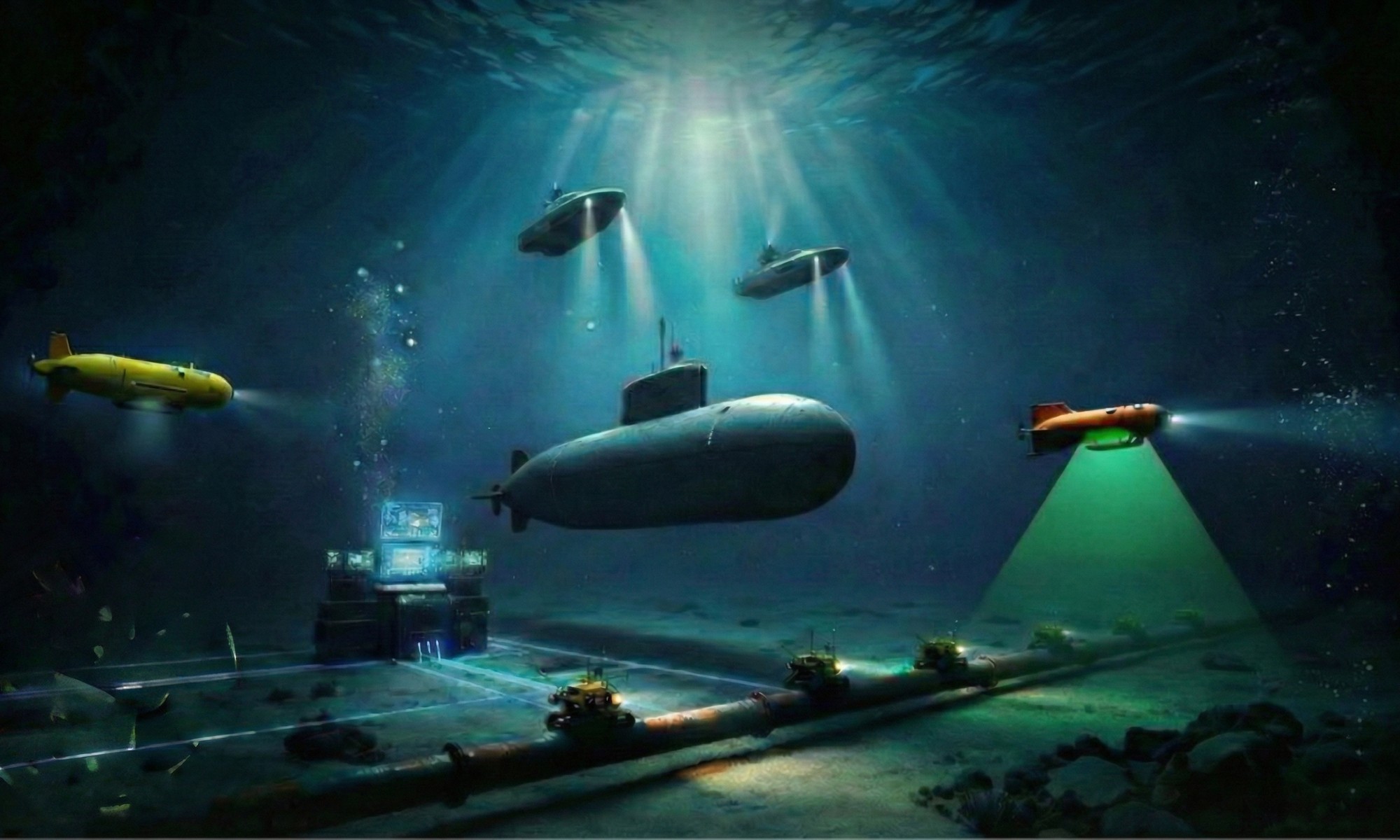
Strategic Pings: The Big Silent Hunters

Executive Summary

Extra-Large Uncrewed Underwater Vehicles, or XLUUVs, are changing
undersea warfare. Not because they are big. Not because they are
unmanned. And not because they look impressive in defense exhibition
renderings.

They matter because they can carry mission payloads into places where
humans should not have to go, stay there for a long time, and collect
acoustic intelligence in a GPS-denied, radio-silent, pressure-heavy
environment.

But here is the uncomfortable truth.

An XLUUV without the right sonar payload is just an expensive
underwater bus.

The platform provides endurance. The payload provides purpose. The
sonar provides understanding.

Why
XLUUVs Are Not Underwater Trucks, They Are Sensor Weapons

For more than a century, the submarine was the apex predator of the
undersea domain. Silent, expensive, crewed, and politically
sensitive.

Now something different is entering the water.

It does not need coffee. It does not need sleep. It does not complain
about hotel points. It can transit quietly, sit near the seabed, map a
cable route, carry payloads, listen for activity, and move again when
the mission requires it.

Welcome to the age of the XLUUV.

The industry loves to talk about size, range, endurance, payload bay,
and autonomy. Fair enough. These things matter. Boeing describes Orca as
an XLUUV with a large modular payload section intended for open-ocean
transit, bottom-following, seabed operations, and mission flexibility.
NAVSEA accepted delivery of the first Orca XLUUV test asset in December
2023, emphasizing the modular payload section for sensors,
communications, and mission-specific systems.

But the real question is not: how far can it go?

The real question is: what can it understand when it gets there?

Because underwater autonomy is not magic. It is acoustics,
navigation, signal processing, and mission doctrine wrapped inside a
pressure hull.

In the air, a drone can use GPS, cameras, radio links, radar, and
satellite communications. Underwater, most of that disappears very
quickly. Radio frequency energy dies. Cameras are range-limited. GPS
does not work at depth. Communications are slow, intermittent, and
acoustic.

The XLUUV relies solely on sound.

That means sonar is not a bolt-on accessory. It is the nervous
system.

For mine warfare and seabed operations, active sonar becomes
critical. Synthetic aperture sonar, or SAS, provides high-resolution
imagery over wide areas and helps solve one of the old problems of
side-scan sonar: resolution degradation at range. Traditional side-scan
sonar can tell you that something interesting may be on the seabed. SAS
gets you closer to understanding what it is, where it is, and whether it
matters.

Multibeam echo sounders add the 3D picture. They provide bathymetry,
slopes, seabed shape, and clearance data. That matters if you are
navigating near the bottom, selecting a payload placement location,
inspecting infrastructure, or avoiding an expensive collision with
geology.

Passive sonar plays a different game. It listens. It does not reveal
itself by transmitting. For ISR, anti-submarine support, pattern-of-life
monitoring, and covert surveillance, passive arrays can be more
important than active imaging. The XLUUV can be equipped with a passive
sonar suite; conformal array, flank array, towed array, and intercept
array. Sometimes the smartest acoustic move is to shut up and
listen.

I did a newsletter about THALES 76Nano sonar for XLUUV, see link
here: https://tinyurl.com/y3n4cvd7

This is where the XLUUV conversation becomes interesting.

Boeing Orca represents the heavy modular approach. Anduril’s Dive-XL
represents a fast-moving, software-heavy approach. In March 2026,
Anduril said the U.S. Navy and DIU selected it for the Combat Autonomous
Maritime Platform project, aimed at advancing extra-large autonomous
underwater vehicles.

XLUUVs carry payloads and provide persistence. Medium UUVs classify
and survey. Small UUVs inspect. USVs communicate, launch, recover, and
relay. Seabed nodes listen. AI helps sort the acoustic mess. Humans
still define intent.

The sonar benchmark remains platforms like Kongsberg’s HUGIN
Superior, even if it is not an XLUUV. It shows what high-end undersea
sensing can look like when the payload is treated as the heart of the
system. Kongsberg states that HUGIN Superior carries HISAS 1032
dual-receiver synthetic aperture sonar, generating about 1,000 meters of
swath at 2.5 knots with consistent high-resolution SAS imagery, along
with an EM2040 Mk II multibeam.

That is the difference between “something is down there” and “that is
a mine-like object, next to a cable, on rippled sand, at this
coordinate.”

Other nations are moving too. The Royal Navy’s XV Excalibur,
developed under Project Cetus, is a 12-meter, 19-ton experimental XLUUV
testbed intended to explore payloads, autonomy, and future
crewed-uncrewed teaming.

China’s new generation of XLUUVs suggests a serious shift in undersea
power. The focus is no longer just on small autonomous underwater
vehicles for survey or inspection. China appears to be moving toward
much larger, mission-capable underwater drones designed for ISR, seabed
operations, mine warfare, and potentially payload delivery. Reports
describe multiple Chinese XLUUV designs, including the AJX-002 and
HSU-100, with some larger concepts reportedly exceeding the scale of the
U.S. Boeing Orca.

The provocative point is that China is not betting on one platform.
It is building a family of large unmanned underwater systems with
different roles, sizes, and likely mission profiles. That gives China
more flexibility than a single-purpose vehicle focused mainly on mine
deployment. Compared with Western efforts such as Orca and emerging
systems like Dive-XL, China’s approach looks broader, faster, and more
aggressive. The undersea competition is moving from experimental
autonomy to deployable sensor-and-payload networks.

Russia continues to pursue a split path between deep-water ISR
vehicles and strategic underwater weapons. The details are often opaque,
and we should be careful not to pretend that every sonar suite is
publicly known.

NOTE: I’m preparing a special newsletter about Russian XLUUVs.

But the trend is obvious.

The undersea domain is becoming more distributed, more autonomous,
and more sensor-driven.

And that leads to the provocative point.

The next undersea arms race will not be won by the country with the
biggest unmanned submarine. It will be won by the country that best
integrates sonar, autonomy, payloads, and mission doctrine into one
coherent undersea system.

Because endurance without sensing is tourism.

Autonomy without sonar is wandering.

And a beautiful XLUUV without acoustic intelligence?

That is just an underwater bus with a defense budget.

So next time someone shows you a sleek unmanned submarine rendering,
ask the uncomfortable question:

Nice hull. What sonar is on it?

Call-To-Action

Please comment and give feedback so we all can learn from each
others.


Originally published in the Strategic Pings ))) newsletter on LinkedIn on 2026-05-26. Subscribe there to get new editions first.

Strategic Ping: XPONENTIAL 2026 and the End of Autonomy Theater

Executive Summary

XPONENTIAL 2026 in Detroit sent a clear signal: maritime autonomy is moving out of the demo tank and into operational reality. The most important story was not a flashy new unmanned hull. It was the hard infrastructure behind autonomy at scale: resilient navigation, assured PNT, communications, manufacturing capacity, sensor integration, and defense-linked logistics.

XPONENTIAL/AUVSI 2026 (credit Xponential)

For maritime operators, the question is changing. It is no longer, “Can we build an unmanned boat?” The real question is, “Can we trust it, scale it, protect it, navigate it under electronic attack, and plug it into real naval and commercial missions?” That is where the serious money, risk, and opportunity now sit.

Autonomy Is Growing Up

XPONENTIAL 2026 framed autonomy as something that must survive contact with the real world. Air, ground, and maritime platforms can no longer live as beautiful prototypes on a trade show floor. They need to operate in weather, traffic, clutter, contested spectrum, defense workflows, ports, chokepoints, and logistics chains.

That matters for the maritime sector because the ocean is a brutal test environment. Saltwater does not care about your investor deck. GPS can be jammed. Communications can disappear. Currents move the platform. Biofouling attacks the sensors. A harbor full of ferries, barges, fishing boats, pier structures, and confused humans is not a clean autonomy problem.

This is why Detroit was an interesting place for the conversation. The city brings manufacturing discipline, mobility thinking, cross-border logistics, and Great Lakes port activity into the autonomy discussion. Maritime autonomy needs exactly that kind of industrial reality check. We do not need more science projects. We need systems that can be built, maintained, deployed, and trusted.

Maritime Autonomy Enters the Defense Conversation

One of the more important signals was the visible presence of maritime autonomy in the policy and defense narrative. The USV Operational Outcomes panel, involving U.S. Navy and Japan Maritime Self Defense Force leadership, pointed directly toward distributed maritime operations and Indo-Pacific deterrence.

That is not a small detail. It means unmanned surface vessels are no longer being treated as exotic side platforms. They are being discussed as part of future force structure, distributed sensing, logistics, surveillance, and operational reach.

The co-location with the Michigan Defense Expo also mattered. It put USV, UUV, port security, coastal surveillance, and defense industrial base conversations in the same room. That is where maritime autonomy starts to become real. Procurement, production, sustainment, and operational integration are often less glamorous than a new hull design, but they decide whether the system actually reaches the fleet.

[Video: Scaling Maritime Autonomy]

The Real Technology Battle: PNT, Comms, and Trust

The strongest technical message from XPONENTIAL was simple: autonomy fails fast when navigation, timing, and communications fail.

Assured PNT in GPS-denied, spoofed, or jammed environments was front and center. For maritime and subsea systems, this is critical. A USV can carry the best sonar payload in the world, but if it cannot hold position, maintain track, understand its own location, or move data reliably, the sensor becomes an expensive passenger.

I have personal experience of this: my USVs were GPS spoofed by the Russian Navy during exercises in the Baltic.

For AUVs and ROVs, the challenge is even sharper. Underwater platforms already operate in a low-bandwidth, high-latency, navigation-poor environment. Add electronic warfare, contested ports, or defense operations, and the autonomy stack must become far more resilient.

The same applies to sensor fusion. Radar, EO/IR, AIS, sonar, inertial navigation, acoustic positioning, and mission software must work as one system. The platform is only the carrier. The capability comes from the payload, data pipeline, autonomy logic, and operator trust.

A USV is not the capability. A USV enables the capability.

The Provocative Takeaway

XPONENTIAL 2026 showed that maritime autonomy is entering its industrial phase. The winners will not be the companies with the most dramatic renderings of unmanned vessels. The winners will be the ones solving the boring, brutal problems: power, payloads, PNT, comms, production, cybersecurity, sustainment, and mission integration.

USVs and Mission Integration

For sonar and maritime autonomy professionals, this is the moment to pay attention. The future will not be decided by hull shape alone. It will be decided by what the platform can sense, how it navigates when GPS lies, how it communicates when bandwidth collapses, and whether the system can produce useful decisions instead of just more data.

The ocean does not reward hype. It rewards systems that work.

Call-To-Action

Please comment and provide your point of view so we all can learn from each other.


Originally published in the Strategic Pings ))) newsletter on LinkedIn on 2026-05-18. Subscribe there to get new editions first.

Strategic Pings: The Sonic Warrior Beneath the Waves

Executive Summary

The ocean is not silent. It never was. Long before humans invented sonar, marine animals had already mastered acoustic detection, deception, deterrence, communication, and, in some cases, outright sonic assault. Whales use sound as long-range sensors and social networks. Snapping shrimp generate cavitation shockwaves. Lobsters rasp warnings at predators. Crabs drum through the seabed. Cleaner shrimp clap to advertise services. Baleen whales sing across ocean basins, while human noise increasingly jams their acoustic world.

The provocative lesson is simple: nature did not copy sonar. Sonar copied nature. And in many ways, nature is still ahead of us.

The Ocean Was Never Silent

We like to call it the “silent world.” Beautiful phrase. Terrible acoustics.

Anyone who has ever listened through a hydrophone knows the truth. The ocean is not quiet. It crackles, booms, clicks, rasps, whistles, sings, snaps, and occasionally sounds like someone dropped a frying pan into a submarine cable trench.

[Video: Physics of Acoustic Warfare]

In water, sound is king. Light disappears quickly. Radio waves are mostly useless. Smell is slow. But sound travels. It bends with temperature and salinity. It reflects from the seabed. It finds prey, mates, rivals, and danger.

Before navies, survey companies, and offshore operators filled the ocean with pings, propellers, echosounders, seismic guns, and thrusters, marine animals had already turned sound into a survival tool. Some use it as radar. Some as a password. Some as a warning. And some use it as a weapon.

Underwater Sonic Warriors

The Sperm Whale: The Deep Ocean’s Heavyweight Sonar

The sperm whale is not just a whale. It is a biological acoustic weapons platform with a digestive system.

These animals dive into the dark ocean and use powerful clicks to hunt squid at depths where sunlight is irrelevant. Scientific work has measured sperm whale clicks at apparent source levels above 230 dB re 1 μPa peak-to-peak at 1 meter. That is not whale poetry. That is serious acoustic power.

Toothed whales, including dolphins, orcas, and sperm whales, use clicks to navigate and identify objects. NOAA describes whale clicks as a way to identify physical surroundings, distinguish objects, and communicate socially.

The strategic point is obvious. Echolocation is not “animal noise.” It is active sonar, refined by evolution, packaged in blubber, and powered by fish.

The Snapping Shrimp: Small Body, Violent Physics

Then we have the snapping shrimp. Tiny animal. Ridiculous acoustic signature.

This little crustacean closes its specialized claw so fast that it creates a high-speed water jet. That jet forms a cavitation bubble. When the bubble collapses, it produces a shockwave and even a flash of light. Nature reported that the collapse indicates pressures and temperatures of at least 5,000 K inside the bubble.

Think about that. A shrimp does not need electronics, batteries, firmware updates, or a NATO stock number. It uses a claw, water physics, and bad attitude.

For sonar people, snapping shrimp are more than a curiosity. In shallow tropical waters, they can dominate the acoustic background. To us, it is clutter. To them, it is lifestyle.

The Spiny Lobster: Acoustic Deterrence

Not every sonic warrior attacks. Some simply say, “Back off.”

Spiny lobsters produce warning sounds using a stick-slip mechanism, similar in principle to a bowed string. Nature reported that this allows them to produce strident warning sounds against predators, even during vulnerable molting periods when their armor is soft. (Nature)

That is elegant engineering. When the armor is weak, increase the acoustic signature. In defense terms, it is deterrence by noise.

And the signal is not trivial. Research on European spiny lobsters found source levels up to 167 dB re 1 μPa for larger animals.

Crabs and Cleaner Shrimp: Sound as Social Protocol

Crabs take a different approach. Fiddler and ghost crabs use rapping, drumming, and substrate vibration. They are not just making noise into the water column. They are using the seabed as a communication channel.

Cleaner shrimp are even more diplomatic. Some clap their claws to advertise cleaning services to reef fish. In one study, cleaner shrimp were more likely to clap when hungry, and clapping individuals were more likely to clean than non-clapping individuals.

In human terms, this is acoustic branding. In reef terms, it says: “Don’t eat me. I am the dental hygienist.”

Baleen Whales: Long-Range Communications Under Attack

At the other end of the scale are baleen whales. Blue, fin, humpback, and right whales use low-frequency sound for communication across enormous distances. NOAA notes that baleen whale frequency ranges overlap with vessels, seismic airguns, pile driving, and echosounders. Human-made sound can mask calls and make it harder for marine mammals to hear each other.

NOAA also uses behavioral disruption thresholds of 120 dB rms for continuous noise and 160 dB rms for impulsive noise in marine mammal assessments.

Here is the uncomfortable part. We often talk about protecting marine life by reducing plastic, spills, and habitat damage. All valid. But we rarely talk enough about acoustic habitat.

For many marine animals, sound is not background. It is their primary sensor.

The Strategic Ping

The ocean is not silent. It is a contested acoustic battlespace.

Whales run biological sonar. Shrimp fire cavitation shockwaves. Lobsters use acoustic deterrence. Crabs drum through the seabed. Cleaner shrimp advertise with sound. Baleen whales operate long-range communication networks that we are increasingly jamming.

So maybe the real lesson is this:

We did not invent underwater acoustics. We industrialized it.

And before we get too proud of our transducers, beamformers, and signal processing, remember this: somewhere on a reef, a shrimp is stunning prey with a bubble. No software license required.


Originally published in the Strategic Pings ))) newsletter on LinkedIn on 2026-05-11. Subscribe there to get new editions first.

Strategic Pings: From Single Beam to Synthetic Clarity

Executive Summary

Side scan sonar has evolved from a military seabed reconnaissance tool into one of the most important technologies in underwater survey, mine countermeasures, offshore energy, archaeology, and critical infrastructure protection. The journey is not just about prettier sonar pictures. It is about better decisions.

The evolution is clear: single beam side scan made the seabed visible. Multi-beam side scan, represented by systems such as the Klein 5000, improved coverage, resolution, and survey efficiency. Newer high-speed multi-beam systems such as the Klein 5900 push that concept further, enabling rapid wide-area search at operationally useful speeds. Then comes the next leap: synthetic aperture sonar, with systems such as Kraken KATFISH, delivering near-photographic seabed imagery with high and consistent resolution across the swath.

The provocative truth is simple: traditional side scan still matters. But vague seabed imagery is becoming harder to defend.

The Evolution of Side Scan Sonar

Side scan sonar did not begin as a commercial survey tool. It began as a military necessity. After World War II, navies needed a better way to detect mines, inspect the seabed, and understand what was hiding in the acoustic shadows. Early systems were heavy, specialized, and built for defense laboratories rather than practical offshore crews.

But they introduced something revolutionary: an acoustic image of the seabed.

That changed everything.

[Video: Evolution of Sidescan Technology]

The classic starting point is single beam side scan sonar. It transmits one fan-shaped acoustic beam to port and one to starboard. As the towfish, hull-mounted system, or AUV moves forward, each ping paints a narrow strip of seabed. Line by line, the system builds an acoustic image. Strong returns appear bright. Shadows appear dark. Objects become visible not only because of what they reflect, but because of the shadows they cast.

This remains a powerful concept. Single beam side scan is relatively simple, robust, cost-effective, and still very useful for search operations, route surveys, archaeology, harbor work, and general seabed imaging.

Martin Klein - the "Father of commercial Sidescan", and his Klein 5000
Martin Klein – the "Father of commercial Sidescan", and his Klein 5000

But physics is not sentimental.

In traditional single beam side scan, along-track resolution is limited by beam width, range, altitude, ping rate, and platform speed. The farther out you look, the larger the acoustic footprint becomes. In plain English, the image gets softer with range. At higher speeds, ping spacing can also become a problem. Push too fast and you may lose coverage, smear details, or reduce classification confidence.

This is where multi-beam side scan entered the story.

The Klein 5000 is an important reference point. Instead of using one beam per side, the Klein 5000 V2 generates multiple adjacent, parallel sonar beams on each side while using beam steering and dynamic focusing. The result is sharper along-track resolution at higher tow speeds and full bottom coverage compared with what conventional single beam side scan can normally achieve.

Left: Old analog Sidescan Sonar - Right: Multibeam Sidescan Sonar
Left: Old analog Sidescan Sonar – Right: Multibeam Sidescan Sonar

That is a major distinction. Multi-beam side scan is not the same as a bathymetric multibeam echo sounder. A multibeam echo sounder is primarily designed to measure depth. A multi-beam side scan is primarily designed to create acoustic imagery, but it uses multiple side-looking beams to improve image quality, speed tolerance, and coverage efficiency.

The Klein 5000 showed that side scan could become more than a picture-making tool. It could become a high-productivity survey sensor.

Then came the next operational demand: speed.

Modern survey, defense, and mine countermeasure missions cannot always afford slow and careful lawnmower patterns. Sometimes the requirement is rapid wide-area search. Sometimes the platform is a USV. Sometimes the mission is moving faster than the survey department would prefer.

That is where systems such as the Klein 5900 become relevant. Klein describes the 5900 as an ultra-high-resolution side scan sonar with integrated gap filler sonar and co-registered bathymetry for high-speed MCM and surveillance missions. It is designed for survey speeds up to 12 knots while maintaining full bottom coverage, with embedded electronics and AI-enabled processing to support target detection and survey efficiency.

This matters because speed changes economics. It changes mission planning. It reduces vessel time. It increases area coverage. For unmanned systems, this is especially important. A USV without a productive sensor is just an expensive remote-controlled boat with good marketing.

Klein Mantis (replacement of Klein 5000)

But even high-speed multi-beam side scan still lives within the world of real aperture sonar. It is very good sonar. But the physical aperture of the array and the geometry of acoustic imaging still constrains it.

Then comes synthetic aperture sonar, or SAS.

SAS changes the processing philosophy. Instead of treating each ping as an independent image line, SAS coherently combines many overlapping pings as the platform moves forward. In effect, the motion of the vehicle creates a much larger “synthetic” array than the physical sonar itself. The benefit is dramatically improved along-track resolution, and more importantly, resolution that can remain far more consistent across the swath.

A strong practical example is Kraken KATFISH. Kraken describes KATFISH as an actively stabilized towed synthetic aperture sonar system. It uses articulated tailfins and an intelligent autopilot to compensate for towfish motion, supporting high-quality SAS data collection and large-area coverage. Kraken lists real-time constant SAS imagery resolution of 3 cm x 3 cm, post-processed resolution down to 2 cm x 2 cm, survey ranges up to 200 meters per side, and standard operating speeds of 4 to 10 knots.

Kraken KatFish Synthetic Aperture Sidescan Sonar

That is not just a prettier sidescan image. That is a different level of seabed intelligence.

With conventional side scan, range is the enemy of clarity. With SAS, range becomes less punishing. Small objects stand out. Shadows become sharper. Mine-like contacts become easier to classify. Pipelines, cables, debris fields, seabed scars, and infrastructure features become more interpretable.

For mine countermeasures, this can reduce uncertainty. For offshore energy, it can improve route and site assessment. For critical underwater infrastructure, it can support better change detection. For autonomy, it provides the kind of sensor output that automated target recognition systems actually deserve.

But let us be clear: SAS does not make traditional sidescan obsolete. That is too simplistic.

Graph showing performance vs price, with examples of each category of Sidescan Sonars

Single beam side scan remains valuable when cost, simplicity, and robustness matter. Multi-beam side scan remains highly relevant when survey productivity, coverage, and image quality must be balanced. High-speed multi-beam systems such as the Klein 5900/Mantis are powerful tools for defense, UXO, offshore, and rapid survey missions. SAS systems such as Kraken KATFISH (or THALES TSAS), sit at the premium end, where resolution, classification confidence, and wide-area seabed intelligence justify the added complexity.

Summary

The evolution of sidescan sonar is really the evolution of underwater understanding.

First, we learned to see the seabed. Then we learned to survey it efficiently. Now we are learning to classify it with confidence.

Detection is cheap. Understanding is expensive. And in the modern underwater battlespace, vague pictures are becoming a luxury we can no longer afford.

Call-To-Action

Please comment and if you have any questions, please feel free to message me.


Originally published in the Strategic Pings ))) newsletter on LinkedIn on 2026-05-05. Subscribe there to get new editions first.