
Executive Summary
Extra-Large Uncrewed Underwater Vehicles, or XLUUVs, are changing
undersea warfare. Not because they are big. Not because they are
unmanned. And not because they look impressive in defense exhibition
renderings.
They matter because they can carry mission payloads into places where
humans should not have to go, stay there for a long time, and collect
acoustic intelligence in a GPS-denied, radio-silent, pressure-heavy
environment.
But here is the uncomfortable truth.
An XLUUV without the right sonar payload is just an expensive
underwater bus.
The platform provides endurance. The payload provides purpose. The
sonar provides understanding.
Why
XLUUVs Are Not Underwater Trucks, They Are Sensor Weapons
For more than a century, the submarine was the apex predator of the
undersea domain. Silent, expensive, crewed, and politically
sensitive.
Now something different is entering the water.
It does not need coffee. It does not need sleep. It does not complain
about hotel points. It can transit quietly, sit near the seabed, map a
cable route, carry payloads, listen for activity, and move again when
the mission requires it.
Welcome to the age of the XLUUV.
The industry loves to talk about size, range, endurance, payload bay,
and autonomy. Fair enough. These things matter. Boeing describes Orca as
an XLUUV with a large modular payload section intended for open-ocean
transit, bottom-following, seabed operations, and mission flexibility.
NAVSEA accepted delivery of the first Orca XLUUV test asset in December
2023, emphasizing the modular payload section for sensors,
communications, and mission-specific systems.
But the real question is not: how far can it go?
The real question is: what can it understand when it gets there?
Because underwater autonomy is not magic. It is acoustics,
navigation, signal processing, and mission doctrine wrapped inside a
pressure hull.
In the air, a drone can use GPS, cameras, radio links, radar, and
satellite communications. Underwater, most of that disappears very
quickly. Radio frequency energy dies. Cameras are range-limited. GPS
does not work at depth. Communications are slow, intermittent, and
acoustic.
The XLUUV relies solely on sound.
That means sonar is not a bolt-on accessory. It is the nervous
system.
For mine warfare and seabed operations, active sonar becomes
critical. Synthetic aperture sonar, or SAS, provides high-resolution
imagery over wide areas and helps solve one of the old problems of
side-scan sonar: resolution degradation at range. Traditional side-scan
sonar can tell you that something interesting may be on the seabed. SAS
gets you closer to understanding what it is, where it is, and whether it
matters.
Multibeam echo sounders add the 3D picture. They provide bathymetry,
slopes, seabed shape, and clearance data. That matters if you are
navigating near the bottom, selecting a payload placement location,
inspecting infrastructure, or avoiding an expensive collision with
geology.
Passive sonar plays a different game. It listens. It does not reveal
itself by transmitting. For ISR, anti-submarine support, pattern-of-life
monitoring, and covert surveillance, passive arrays can be more
important than active imaging. The XLUUV can be equipped with a passive
sonar suite; conformal array, flank array, towed array, and intercept
array. Sometimes the smartest acoustic move is to shut up and
listen.
I did a newsletter about THALES 76Nano sonar for XLUUV, see link
here: https://tinyurl.com/y3n4cvd7
This is where the XLUUV conversation becomes interesting.
Boeing Orca represents the heavy modular approach. Anduril’s Dive-XL
represents a fast-moving, software-heavy approach. In March 2026,
Anduril said the U.S. Navy and DIU selected it for the Combat Autonomous
Maritime Platform project, aimed at advancing extra-large autonomous
underwater vehicles.
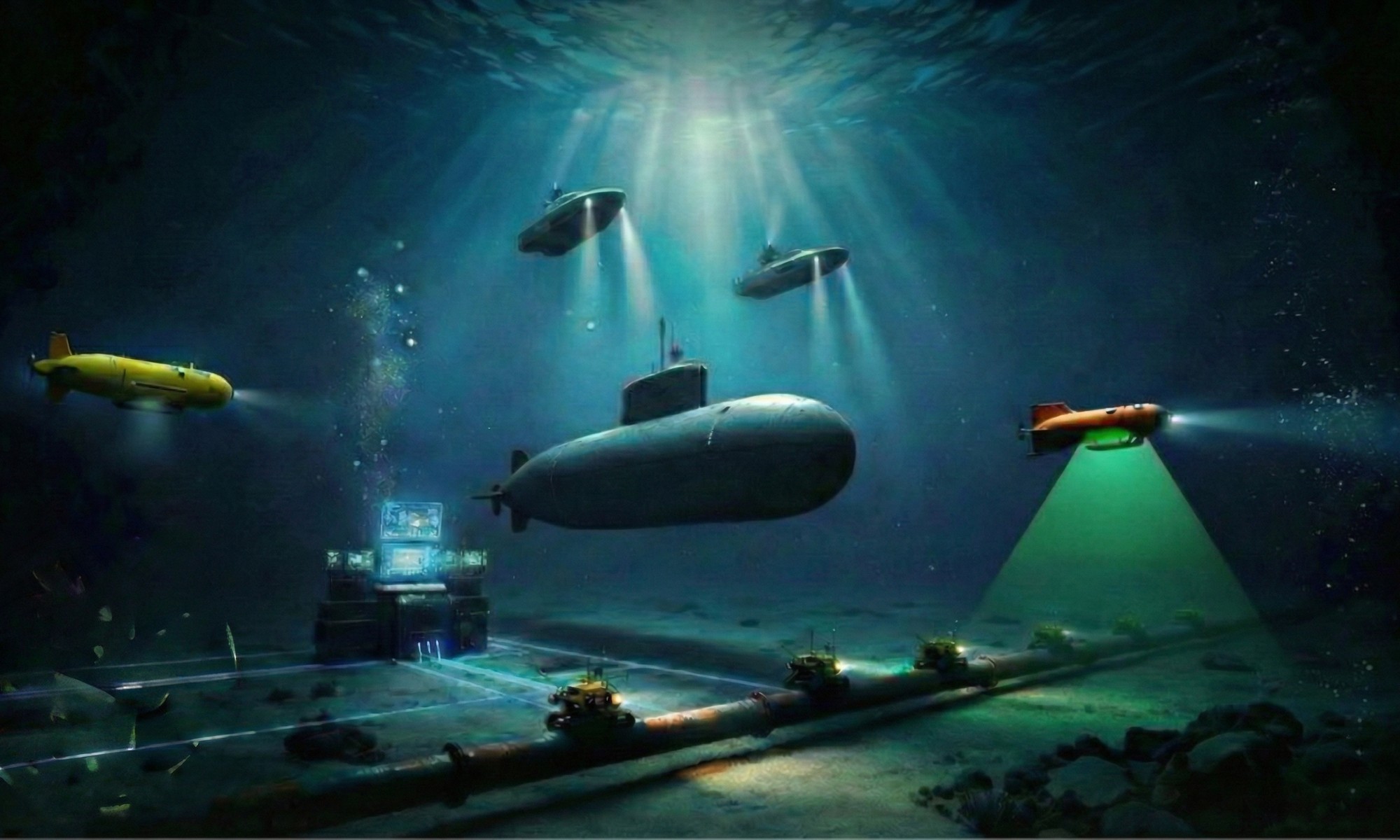
XLUUVs carry payloads and provide persistence. Medium UUVs classify
and survey. Small UUVs inspect. USVs communicate, launch, recover, and
relay. Seabed nodes listen. AI helps sort the acoustic mess. Humans
still define intent.
The sonar benchmark remains platforms like Kongsberg’s HUGIN
Superior, even if it is not an XLUUV. It shows what high-end undersea
sensing can look like when the payload is treated as the heart of the
system. Kongsberg states that HUGIN Superior carries HISAS 1032
dual-receiver synthetic aperture sonar, generating about 1,000 meters of
swath at 2.5 knots with consistent high-resolution SAS imagery, along
with an EM2040 Mk II multibeam.
That is the difference between “something is down there” and “that is
a mine-like object, next to a cable, on rippled sand, at this
coordinate.”
Other nations are moving too. The Royal Navy’s XV Excalibur,
developed under Project Cetus, is a 12-meter, 19-ton experimental XLUUV
testbed intended to explore payloads, autonomy, and future
crewed-uncrewed teaming.
China’s new generation of XLUUVs suggests a serious shift in undersea
power. The focus is no longer just on small autonomous underwater
vehicles for survey or inspection. China appears to be moving toward
much larger, mission-capable underwater drones designed for ISR, seabed
operations, mine warfare, and potentially payload delivery. Reports
describe multiple Chinese XLUUV designs, including the AJX-002 and
HSU-100, with some larger concepts reportedly exceeding the scale of the
U.S. Boeing Orca.
The provocative point is that China is not betting on one platform.
It is building a family of large unmanned underwater systems with
different roles, sizes, and likely mission profiles. That gives China
more flexibility than a single-purpose vehicle focused mainly on mine
deployment. Compared with Western efforts such as Orca and emerging
systems like Dive-XL, China’s approach looks broader, faster, and more
aggressive. The undersea competition is moving from experimental
autonomy to deployable sensor-and-payload networks.
Russia continues to pursue a split path between deep-water ISR
vehicles and strategic underwater weapons. The details are often opaque,
and we should be careful not to pretend that every sonar suite is
publicly known.
NOTE: I’m preparing a special newsletter about Russian XLUUVs.
But the trend is obvious.
The undersea domain is becoming more distributed, more autonomous,
and more sensor-driven.
And that leads to the provocative point.
The next undersea arms race will not be won by the country with the
biggest unmanned submarine. It will be won by the country that best
integrates sonar, autonomy, payloads, and mission doctrine into one
coherent undersea system.
Because endurance without sensing is tourism.
Autonomy without sonar is wandering.
And a beautiful XLUUV without acoustic intelligence?
That is just an underwater bus with a defense budget.
So next time someone shows you a sleek unmanned submarine rendering,
ask the uncomfortable question:
Nice hull. What sonar is on it?
Call-To-Action
Please comment and give feedback so we all can learn from each
others.
Originally published in the Strategic Pings ))) newsletter on LinkedIn on 2026-05-26. Subscribe there to get new editions first.