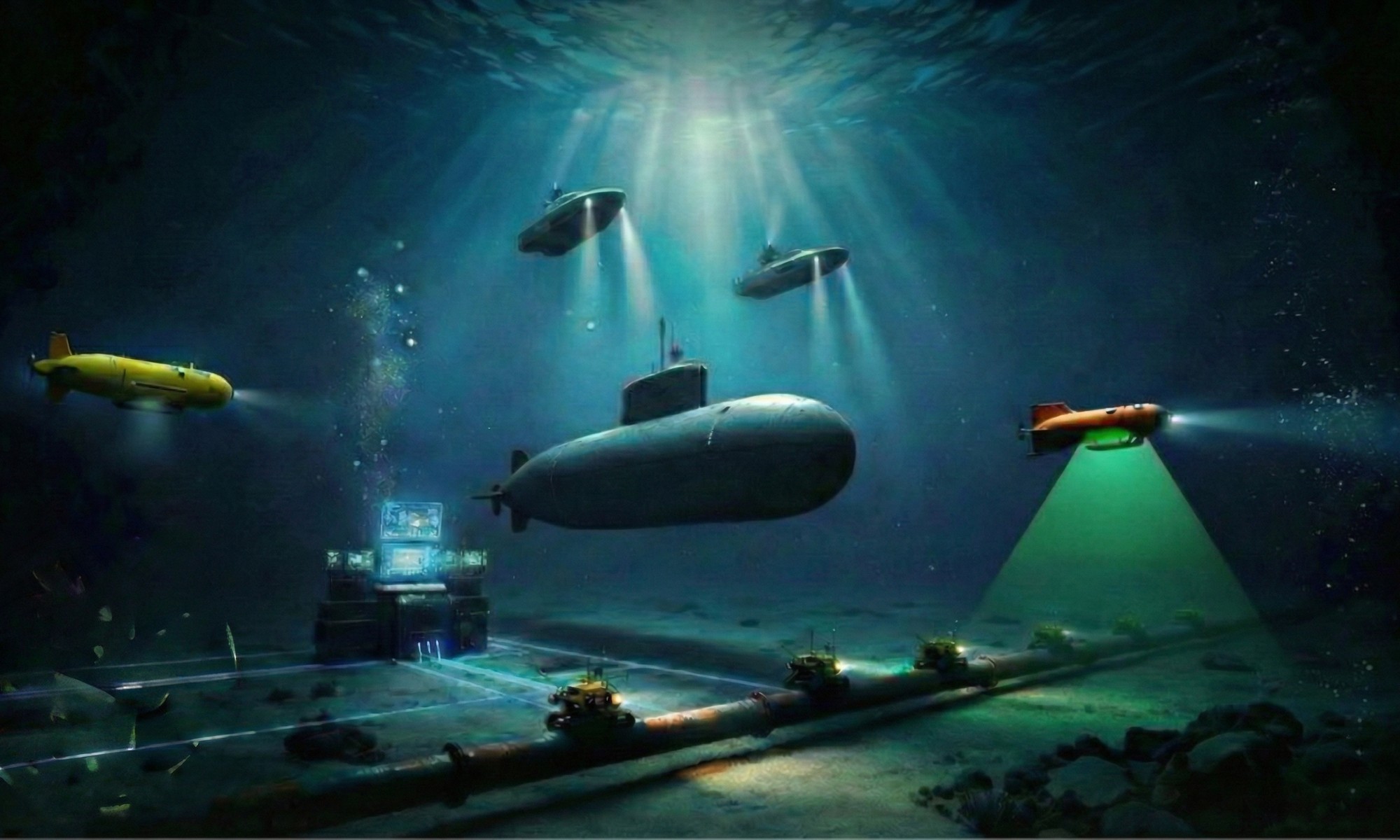

Executive Summary
Poland’s order for three A26-type submarines under the Orka program is more than a long-overdue fleet replacement. It is a strategic decision about who will understand, control, and, when necessary, deny access to the Baltic seabed.
The approximately SEK 47 billion (approx. USD 4.9 billion) contract includes three submarines, weapons, training, and support, with final deliveries scheduled during 2038. Poland is therefore buying more than hulls and torpedoes. It is rebuilding submarine competence while gaining a platform designed to deploy special forces, operate autonomous underwater vehicles, conduct intelligence missions, and support seabed warfare.
That last mission is becoming urgent.
The sabotage of the Nord Stream 1 and Nord Stream 2 pipelines, damage to Balticconnector, and repeated incidents involving power and telecommunications cables have demonstrated how exposed the Baltic’s underwater infrastructure has become. NATO responded by launching Baltic Sentry in January 2025 to increase surveillance and protection of critical undersea infrastructure.
The strategic question is no longer simply whether a submarine can sink another ship.
It is whether it can quietly understand what is happening across the water column and on the seabed before anyone else does.
The Baltic Does Not Reward the Biggest Submarine
Naval power is often measured in displacement, missile cells, speed, and endurance.
The Baltic Sea has its own scoring system.
It is shallow, confined, heavily trafficked, and acoustically difficult. Salinity changes dramatically between regions. Temperature layers distort propagation. Merchant shipping, fishing vessels, coastal industry, and biological activity create persistent background noise.
In this environment, a larger submarine does not automatically have an advantage. Size can become another acoustic and maneuvering problem.
I learned this during my time in the Royal Swedish Navy/FMV working with submarines and passive sonar. One of my projects was introducing flank-array sonar into the Swedish submarine force. The first installation was on the A14-class submarine HMS Neptun under a project called Snäckan (The Shell). We used a huge rubber band around the submarine to mount the first prototype of the flank array.
I later served as deputy project manager for the CSU 83 passive sonar for Västergötland Class (A17), then project manager and the first customer for the ATLAS CSU-90 passive sonar developed for the A19 Gotland Class Submarine. The CSU-90 formed part of the technical lineage that led toward the modern passive-sonar architecture found in the Blekinge program and now intended for Poland’s Orka submarines.
I mention this because passive sonar performance cannot be separated from the environment where it must operate.
A system that performs beautifully in deep Atlantic water may have a far less enjoyable day in the Baltic.
The operator must separate real targets from bottom interaction, own-ship noise, commercial traffic, transient contacts, and propagation conditions that can change over relatively short distances. The decisive capability is not simply detecting noise. It is turning imperfect acoustic information into a trusted tactical picture.
Detection is cheap.
Understanding remains expensive.
A Submarine Designed Around Its Environment
Saab describes the A26 as a fifth-generation submarine. The label is open to debate, but the operational concept represents a clear step beyond the traditional diesel-electric attack boat.
The A26 is designed for covert surveillance, intelligence collection, special operations, mine warfare, anti-submarine warfare, seabed missions, and the deployment of autonomous systems. It also incorporates an X-rudder and an architecture intended for precise maneuvering and operations close to the seabed.
Its Stirling air-independent propulsion system reduces the frequency with which the boat must snorkel to recharge its batteries. That matters because snorkeling creates opportunities for radar, infrared, electronic-support, airborne, and increasingly autonomous surveillance systems to detect the submarine.
Silence does more than protect the boat.
It gives the commander time.
Time to listen. Time to classify. Time to build a pattern of life. Time to wait until the tactical situation favors action.
Patience is still one of the most effective weapons carried by a submarine.
Orka as an AUV Mothership
The most strategically interesting feature of the A26 may not be its torpedo armament.
It is the Multi-Mission Portal.
The portal is a large horizontal lock integrated into the bow. Saab describes it as approximately six meters long and 1.5 meters in diameter, allowing divers, special forces, swimmer vehicles, and uncrewed underwater vehicles (AUVs/UUVs) to enter or leave the submarine while submerged.
This turns the Polish Orka submarine into something more than an underwater weapons platform.
It becomes an AUV mothership. Think Starship Enterprise underwater…
An AUV launched covertly from the submarine could move ahead to inspect a suspected minefield, map a cable corridor, investigate an unknown seabed object, gather intelligence, or place a sensor in a strategically important location. Saab is already developing its Autonomous Ocean Drone, like the AUV 62R, to operate alongside submarines equipped with the Multi-Mission Portal, including the Blekinge class.
The submarine does not need to expose itself by moving directly over every object of interest. It can remain at a safer distance while the autonomous vehicle approaches, collects data, and returns.
That is a significant tactical change.
The submarine becomes the covert command node. The AUV becomes its forward sensor, surveyor, courier, or seabed intervention tool.
In practical terms, the Orka submarine will have longer arms and better underwater eyesight than its hull dimensions suggest.
Seabed Warfare Has Arrived in the Baltic
For decades, submarine warfare concentrated primarily on ships and other submarines.
The target set has expanded.
The Baltic seabed carries pipelines, electricity interconnectors, fiber-optic communications cables, offshore energy infrastructure, military sensors, and the physical connections supporting modern European society.
Nord Stream showed that major Critical Underwater Infrastructure (CIU) could be attacked below the surface with little immediate warning. Subsequent damage to energy and telecommunications links confirmed that this was not an abstract vulnerability. NATO now openly treats the protection of CUI as a continuing military priority.
Protecting every kilometer of cable with frigates and patrol aircraft is impossible.
A modern protection model therefore needs persistence, autonomous inspection, acoustic surveillance, intelligence fusion, and rapid classification of changes on the seabed.
This is where the Orka-A26 combination becomes particularly relevant.
A submarine operating covertly can monitor suspicious vessel activity, deploy AUVs to inspect vulnerable corridors, identify foreign seabed systems, support special forces, and collect acoustic intelligence without advertising the scope or location of the operation.
It can also help establish a baseline.
You cannot identify a meaningful seabed change unless you know what was there yesterday.
Persistent seabed mapping and repeat inspection allow operators to detect new objects, displaced cables, anchor scars, possible explosive devices, or unfamiliar autonomous systems. This is the underwater version of pattern-of-life analysis.
The AUV gathers the evidence.
The submarine protects the operation.
The crew interprets what the machines find.
The Sonar Remains the Center of Gravity
The portal may give the A26 hands, but passive sonar gives it judgment.
In the Baltic, this requires more than a sensitive hydrophone. The sonar architecture must combine bow array, flank arrays, intercept sensors, towed array, ranging information, environmental data, and tactical intelligence without overwhelming the operators.
Flank arrays are especially valuable because their long aperture can improve low-frequency passive detection and bearing estimation. Yet hardware alone does not solve the problem. Array position, platform self-noise, flow noise, processing, beamforming, tracking logic, operator training, and knowledge of local propagation all affect the result.
This is why the evolution from Neptun (A14) and Snäckan (The Shell) Flank Array Sonar, through the CSU-90 on the Gotland class, to the modern sonar architecture of Blekinge matters.
Each generation builds on lessons learned in the same difficult waters.
The Baltic is an unforgiving laboratory. It quickly exposes the difference between impressive specifications and operationally useful sonar.
The Provocative Part
Poland has selected an advanced submarine, but signing a contract does not alter the Baltic balance overnight.
The final deliveries are scheduled during 2038. That creates a long period in which Poland must retain crews, rebuild doctrine, develop infrastructure, establish industrial support, and absorb a sophisticated new operational concept.
The risk is obvious.
A submarine program can become obsessed with steel, schedules, and political ceremonies while neglecting sonar competence, tactical training, autonomous-system integration, and days at sea.
A submarine alongside the pier is an expensive pressure vessel.


