
Executive Summary
China’s apparent 205-meter submarine-drone mothership could provide the support infrastructure for a more persistent autonomous undersea presence. But the most revealing story runs along the drones’ hulls: sonar. China’s extra-large and larger experimental underwater vehicles suggest different acoustic priorities, from obstacle avoidance to passive surveillance and potential combat roles. Their precise capabilities remain uncertain. The strategic lesson is clear: hull size creates possibilities; sensor selection, acoustic performance, and integration determine whether those possibilities become useful capabilities.
The Floating Garage Gets Serious
The next potential disruption in undersea warfare might be a garage.
A very large, floating garage—with room for underwater robots that make “drone” sound misleadingly modest.
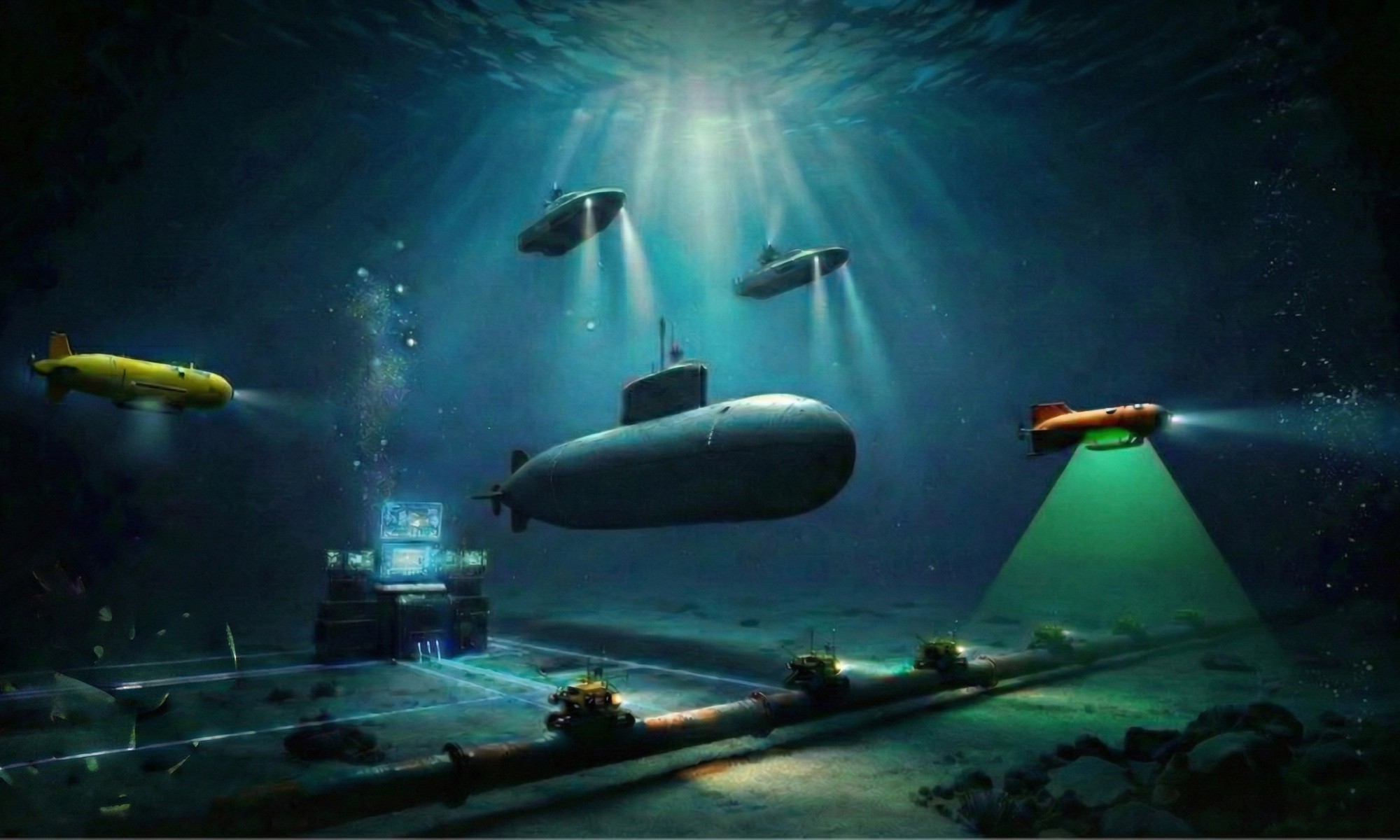
At Shanghai’s Hudong-Zhonghua shipyard, imagery reviewed by naval analyst H. I. Sutton shows what he assesses as a likely submarine-drone mothership. Its apparent configuration includes an internal hangar and a cradle-based launch-and-recovery arrangement. Its precise mission remains unconfirmed.

If that assessment holds, the vessel could support maintenance and repeated deployments closer to operating areas. Batteries need replenishment, equipment needs attention, and vehicles need recovering when the ocean becomes uncooperative.
Anyone can unveil a prototype. Keeping it working offshore is where engineering meets the invoice.
The Sonar Tells You What the Drone Is For
China is developing a family of extra-large uncrewed underwater vehicles, or XLUUVs, alongside much larger prototypes often called XXLUUVs.

These platforms should not be treated as interchangeable underwater robots. Their sensor configurations offer clues about their intended jobs.
Submerged vehicles cannot depend on continuous conventional radio links. They need onboard sensing and navigation to operate through communication gaps. Sonar is central, alongside navigation instruments and mission software.
The useful question is therefore more demanding than “How big is it?”
What can it hear, what can it distinguish, and what can it safely decide.
Flank Arrays: Listening Along the Hull
At NAVDEX 2023, CSSC’s 705 Institute displayed an XLUUV design with an elongated hull-side structure that Sutton identified as consistent with a flank sonar array. The same design showed apparent doors for four torpedo tubes beneath the nose.
That combination suggests an anti-ship or anti-submarine role. It does not establish that an operational vehicle independently selects targets and fires weapons. Exhibition imagery reveals design intent more readily than operational maturity.
A flank array distributes acoustic receivers along the hull. In passive operation, it listens for sound rather than transmitting a ping. A suitably designed aperture can improve directional discrimination, helping processing systems separate contacts and estimate bearings.

But performance depends on frequency, array design, processing, the acoustic environment, and the vehicle’s own noise.
A long array attached to a noisy platform can become an excellent instrument for listening to itself.
The integration work deserves as much attention as the array’s dimensions.
AJX002: A Different Mission, a Different Sonar
The approximately 20-meter AJX002, publicly displayed in 2025 as a minelaying system, illustrates another approach.

Sutton’s imagery assessment identifies a small nose-mounted obstacle-avoidance sonar and no visible flank array. That configuration is consistent with a vehicle emphasizing transit and payload delivery over searching for moving targets.
Forward-looking obstacle-avoidance sonar helps a vehicle detect hazards along its path. It should not automatically be described as a detailed seabed-mapping system or proof of precision navigation. Those functions depend on the complete sensor and navigation package.
Likewise, the suggestion that AJX002 carries the displayed AQS003A mine remains an assessment, rather than a confirmed payload specification.
The procurement lesson is useful: different missions justify different acoustic payloads. Buying more sonar does not automatically buy more mission success.
XXLUUVs: Bigger Ears, Bigger Integration Problems
Imagery analysis around Hainan has identified enormous apparent uncrewed submarine prototypes, with published length estimates roughly spanning 35–45 meters.
That scale could accommodate longer acoustic arrays, more processing equipment, and greater energy reserves. It creates opportunities for capable sonar installations, although their actual configurations remain undisclosed.
Claims that these vehicles can track Western submarines while remaining “virtually silent” go beyond the available evidence.
AI-assisted processing may help distinguish contacts from background noise. It cannot manufacture acoustic information that the sensors never captured.
Detection, classification, localization, and sustained tracking are separate achievements. A fleeting contact is a starting point.
The ocean does not read the procurement brochure.
A Sensor Network Still Needs to Communicate
The broader opportunity is to combine mobile sonar platforms with fixed acoustic sensors and surface relays.
China has demonstrated relevant building blocks. In 2018, researchers at the Shenyang Institute of Automation reported South China Sea trials in which Haiyi acoustic gliders collected environmental and acoustic information, retrieved moored-instrument data through underwater acoustic communications, and relayed data by satellite.
That demonstrates a useful observation-and-communication architecture. It does not prove that China’s military XLUUVs are integrated into a seamless, operational submarine-tracking network.
Acoustic links face bandwidth limits, delays, and variable propagation. Satellite connections require a suitable surface gateway or exposed antenna. Contact reports and selected data may be more practical to transmit than continuous raw sonar streams.
The ocean remains a terrible place to hold a group chat.
Summary: Buy the Mission, Then the Payload
China’s apparent mothership and expanding underwater vehicle family deserve attention because they suggest investment across platforms, sensors, and support infrastructure.

For sonar users, the lesson is immediate: match the payload to the mission, the environment, and the host platform. Evaluate useful information delivered, energy consumed, integration demands, and performance under realistic conditions.
A payload that fits inside the hull can still be wrong for the job.
At Strategic Sonar Solutions Inc., I help clients select the right sensor payload for crewed and autonomous platforms, including USVs and UUVs/AUVs.
Planning a new platform or upgrading an existing one? Message me on LinkedIn to discuss your mission, operating environment, and sensor requirements. Let’s make your next payload earn its place onboard.
Originally published in the Strategic Pings ))) newsletter on LinkedIn on 2026-10-13. Subscribe there to get new editions first.


