
Executive Summary
Ukraine has changed the naval conversation in the Black Sea. A country with almost no traditional navy has forced one of the world’s major fleets to pull back, disperse, hide, and rethink how it survives at sea.
The real lesson is not that unmanned surface vessels are clever. The lesson is that cheap, fast, expendable maritime systems can compress the kill chain faster than legacy navies can adapt. A small unmanned boat with a warhead, a camera, onboard autonomy, and enough range can now threaten ships that cost hundreds of millions of dollars.
This is a warning shot for every navy still measuring power mainly in tonnage, hull count, and exquisite platforms. Ukraine’s USV campaign shows what happens when innovation cycles move in months while procurement cycles move in decades.
For sonar, autonomy, and maritime systems professionals, the Black Sea is not just a war story. It is a live laboratory. Navigation under jamming, last-mile autonomy, passive and active sensing, modular payloads, drone-carrier USVs, and semi-submersible systems are all becoming part of the new naval toolkit.
The uncomfortable question is simple: are we building fleets to fight the next war, or are we building bigger targets?
The Black Sea Wake-Up Call
Navies love hierarchy. Frigates screen destroyers. Destroyers protect carriers. Submarines hunt in silence. Amphibious ships wait for the beach. Everything has a role, a doctrine, and a procurement file thick enough to stop small-arms fire.
Then Ukraine arrived with what looked like explosive jet skis.
The result has been strategically brutal. Ukraine has used unmanned surface vessels, missiles, intelligence, and rapid iteration to push the Russian Black Sea Fleet away from parts of its own operating area. This is not a minor tactical nuisance. This is sea denial created by a nation without a blue-water navy.
That should make every admiral sleep badly.

The classic naval assumption was that expensive ships created control. Ukraine has shown that persistent, expendable, networked systems can deny control at a fraction of the cost. A $100,000 to $250,000 unmanned attack craft does not need to “win” against a $500 million warship in a fair fight. It only needs to find it, reach it, and damage it badly enough to change behavior.
That is the new math of maritime warfare.
From Suicide Boat to Modular Naval System
The first Ukrainian USVs were often described as “suicide boats.” That description is technically useful but strategically too small.
These systems are evolving from one-way explosive craft into modular maritime platforms. The Magura family brought speed, range, and a meaningful payload. Sea Baby added larger warheads and modular strike options. Newer systems such as Katran-type craft point toward faster, more flexible, multi-role configurations.
The direction is clear. The USV is no longer just a floating bomb. It is becoming a maritime truck for payloads.
That payload can be explosive. It can be sensors. It can be rockets. It can be loitering munitions. It can be a small aerial drone launched from the sea. It can even be air-defense missiles carried on a surface drone.
That is where this gets interesting and uncomfortable.
A traditional ship is designed around mission sets. A modular USV can be configured around the target. One week it attacks a ship. The next week it scouts a coastline. Then it carries FPV drones against air-defense radars. Then it acts as a decoy. Then it becomes a hunter.
The platform becomes less important than the payload, the software, and the kill chain.
That should sound familiar to anyone working with sonar, autonomy, hydrography, mine countermeasures, or ISR. The vehicle enables the capability. It is not the capability by itself.
Autonomy Is Now Survival, Not Marketing
The Black Sea has also exposed a hard truth about remote control. If the enemy can jam you, spoof you, or cut your data link, then a purely remote-controlled system becomes fragile.
That is why last-mile autonomy matters.
When a USV closes on a defended target, the electronic environment becomes ugly. GNSS can be jammed. Communications can be degraded. The operator may lose the video feed. The platform still has to navigate, avoid obstacles, recognize the target area, and complete the mission.
That requires onboard processing. It requires sensor fusion. It requires visual navigation, inertial systems, radar or optical cues, and enough autonomy to keep going when the link gets thin.
This is not science fiction. This is practical survival engineering.
For maritime autonomy, the lesson is direct: the communication link is no longer the brain. The link is guidance. The brain must increasingly live onboard the platform.
This has major implications for all unmanned maritime systems, including USVs, UUVs, AUVs, and hybrid semi-submersibles. In contested waters, autonomy is not a luxury feature. It is the difference between a weapon that fails when jammed and a weapon that keeps hunting.
The Sonar and Sensing Angle
Surface drones get most of the attention because the videos are dramatic. But the next layer is underwater.
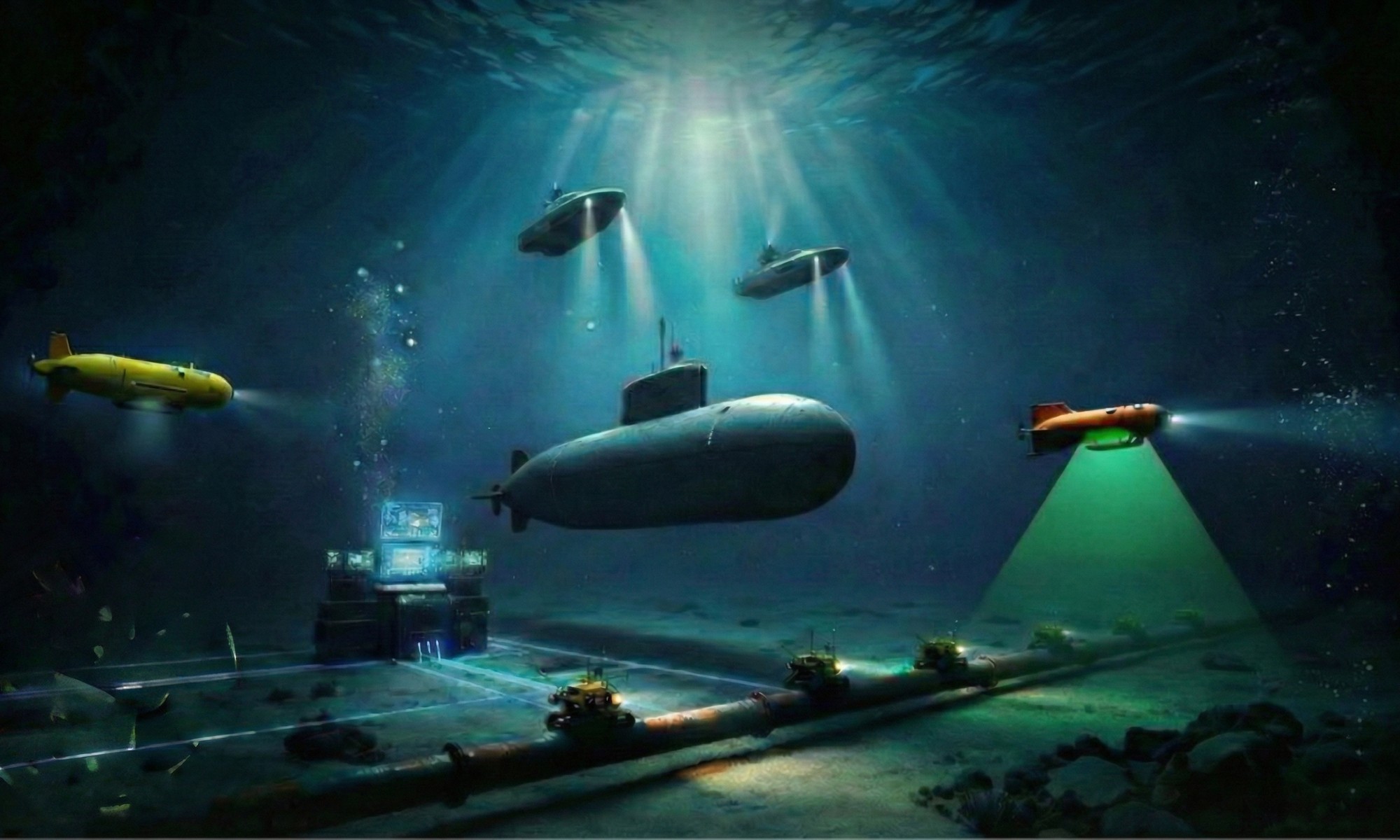
Semi-submersible and underwater systems shift the problem from visible surface defense to detection, classification, and tracking below the surface. This brings sonar back into the center of the story.
A semi-submerged vehicle can reduce radar exposure. An underwater vehicle can loiter, listen, and approach from below. Passive sonar can detect machinery signatures. Active sonar can support final localization. Inertial and acoustic navigation can help when GNSS is unavailable.

That creates a very different defensive problem.
Ships are built to defend against missiles, aircraft, torpedoes, and mines. They are less comfortable when small, cheap, semi-autonomous systems blur those categories. Is it a mine? A torpedo? A drone? A decoy? A sensor? A weapon carrier?

The answer may be yes.
That ambiguity is part of the power.
The Drone Carrier at Sea
One of the most provocative developments is the maritime mother-drone concept.
A USV can carry aerial drones close to a coastline, launch them from unexpected angles, and attack sensors, radars, vehicles, or air-defense systems behind the front line. This breaks the normal geography of attack.
The coastline becomes a launch corridor. The sea becomes a hidden runway. The USV becomes a small carrier.
For defenders, this means the maritime threat no longer ends at the waterline. A surface drone may be carrying another drone. A boat may be a launcher. A launcher may be a decoy. A decoy may be mapping defenses for the next strike.
This is where cheap systems become expensive problems.
The Big Navy Problem
Large navies should not dismiss this as a Ukraine-only story. The Black Sea is a warning, not an exception.
Big ships still matter. Submarines still matter. Air defense still matters. Logistics still matter. But the balance is changing. Expensive platforms now need to defend themselves against mass, speed, deception, autonomy, and low-cost saturation.
That creates a brutal procurement question.
Can a navy afford to defend every high-value ship against swarms of cheap autonomous systems? Can it reload fast enough? Can it detect small surface contacts in clutter? Can it classify them early enough? Can it fight when GNSS is denied and data links are jammed?
The uncomfortable answer is that many fleets are not ready.
They are built around exquisite capability, not fast adaptation. Ukraine is proving that iteration speed can become a weapon. Three-month learning cycles are beating thirty-year acquisition habits.
Final Ping
The Black Sea has delivered a message in saltwater and steel.
The future navy will still need powerful ships, submarines, aircraft, and trained crews. But it will also need cheap mass, modular payloads, autonomous navigation, resilient sensing, and the humility to learn from smaller players moving faster.
The mosquito fleet is not a replacement for the navy.
Originally published in the Strategic Pings ))) newsletter on LinkedIn on 2026-06-01. Subscribe there to get new editions first.