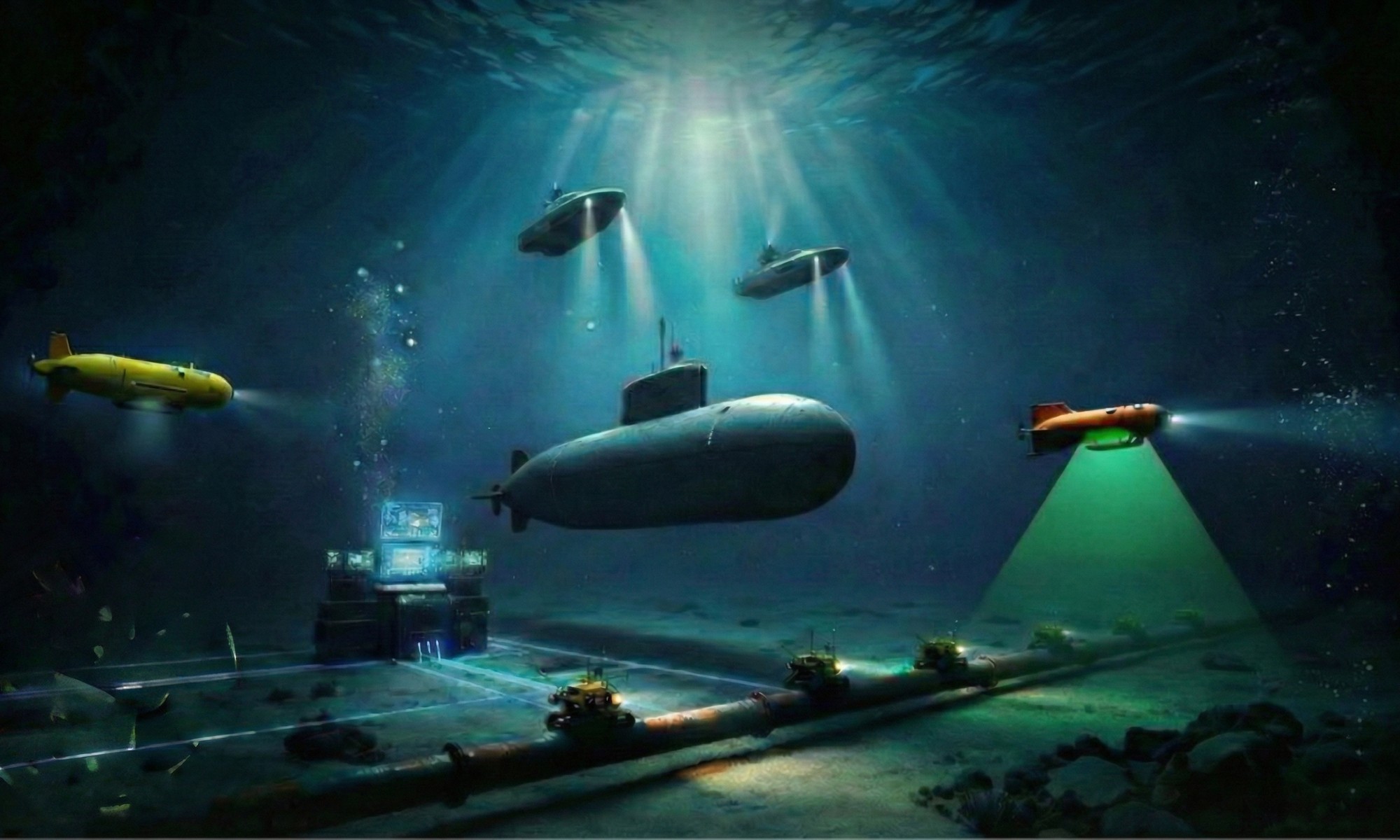

The recent recovery of a Chinese UUV in the Lombok Strait should not be treated as a strange maritime footnote. It should be treated as a warning.
Because this was never just about one unmanned vehicle drifting into the wrong place. It was about what that vehicle was likely doing before it was found. And that matters a great deal.

For those of us who have spent years working with sonar, seabed mapping, underwater surveillance, and the brutal realities of acoustic performance, the signal is obvious. China is not only investing in undersea platforms. It is investing in understanding the water itself. That is a much bigger strategic issue.
The undersea battlespace is changing. Quiet platforms still matter. Stealth still matters. But stealth is no longer just about hull design, propulsion, or signature reduction. It is increasingly about who knows the environment best.
And in chokepoints like Lombok, the environment is the weapon.
The Lombok Strait is not just another narrow passage in Southeast Asia. It is one of the few deep-water routes through the Indonesian archipelago that can support submarine transit at meaningful operational depth. That alone makes it strategically interesting. Unlike shallower alternatives, Lombok offers a valuable acoustic corridor for movement between the Pacific and Indian Oceans. If you want to understand where submarines can move quietly, where they may hide, and where their acoustic advantage may begin to weaken, this is exactly the kind of place you study.
Relentlessly.
That is why the technical payload matters more than the paint job or the logo on the hull.
A UUV operating in such an area is not just collecting data. It is building a model of the battlespace. With the right sensor package, it can measure currents, water column structure, seabed topography, ambient noise, and acoustic variability over time. In plain language, it can help answer the questions every submarine commander and every ASW planner cares about.
Where does sound bend?
Where does it die?
Where does the sound travel well?
Where can a submarine disappear?
And where can a submarine be found?
An Acoustic Doppler Current Profiler does not just measure current speed. It helps define the movement of the water itself, including layering and flow conditions that affect station-keeping, sensor performance, and long-endurance loitering. Temperature and salinity sensors do not just produce oceanographic charts. They define thermoclines, haloclines, sonic layer depth, and transmission loss behavior. That means they help predict where sonar performs well and where it does not. Side-scan sonar is not just for pretty seabed pictures. It helps characterize bottom type, terrain complexity, and bathymetric features that may support covert movement or influence acoustic clutter. Ambient noise monitoring helps separate biological, hydrodynamic, and commercial noise from actual targets, which is essential if you want to refine detection thresholds and improve acoustic libraries.
This is where the discussion often gets too polite.
We still hear people describe these kinds of deployments as scientific, exploratory, or dual-use. That is technically true in the same way that a rangefinder can be used for golf or gunnery. Context matters. Intent matters. Pattern matters.
And the pattern is clear.
China is steadily building the foundations for a more transparent undersea battlespace. Not transparent for everyone. Transparent for them.
That is the strategic point. If you can characterize the acoustic properties of key chokepoints, deep-water approaches, and naval transit corridors, you begin to reduce uncertainty. If you reduce uncertainty, you reduce the value of your adversary’s stealth. If you reduce the value of stealth, you begin to shift the balance of undersea deterrence.
That is not a research project. That is preparation.
The Lombok recovery also matters because it fits into a broader trend. This is not about a single vehicle, a single transit route, or a single regional incident. It is part of a larger push toward distributed, persistent, autonomous undersea sensing. The goal is not simply to place more hardware in the water. The goal is to create a better acoustic picture over wider areas, over longer periods, with less human presence and lower political visibility.
That last point is important.
Archipelagic states and maritime democracies face a difficult challenge here. Surface intrusions are visible. Airspace incursions are visible. Even fishing militia can be photographed and named. But undersea data collection sits in a murkier zone. It is often non-kinetic. Often deniable. Often wrapped in the language of marine science or civilian research. That makes it attractive. It also makes it dangerous.
Because by the time the real purpose is fully understood, the data has already been collected.
So what should serious maritime nations do?
First, stop treating Undersea Domain Awareness as an optional luxury. It is becoming a baseline requirement.
Second, invest in fixed and distributed acoustic monitoring across critical corridors, ports, and seabed infrastructure zones. Not as Cold War nostalgia, but as modern layered sensing architecture.
Third, expand the use of multi-static and bi-static sonar concepts for detecting low-observable unmanned systems that do not behave like traditional submarines and do not present a convenient surface signature.
Fourth, establish disciplined recovery, exploitation, and technical intelligence procedures for foreign unmanned systems. Every recovered vehicle is not just an incident. It is a floating database.
And finally, accept a hard truth. If your competitor is persistently mapping the acoustic environment in peacetime, they are not preparing for scientific dialogue. They are preparing for positional advantage.
The undersea domain used to favor the side that could hide best.
Now it increasingly favors the side that has measured the water first.
That is why the Lombok Strait matters.
China is not just deploying UUVs.
It is mapping the silence.
Call-To-Action
Please comment so we can learn from each other.
Originally published in the Strategic Pings ))) newsletter on LinkedIn on 2026-04-14. Subscribe there to get new editions first.