
Executive Summary
Maritime power is becoming quieter, harder to see, and more difficult to defend.
Navies still measure strength in hulls, aircraft, missiles, and tonnage. Yet the decisive contest is increasingly taking place below the waterline, where sound becomes sight and a relatively inexpensive UUV can threaten assets worth billions.
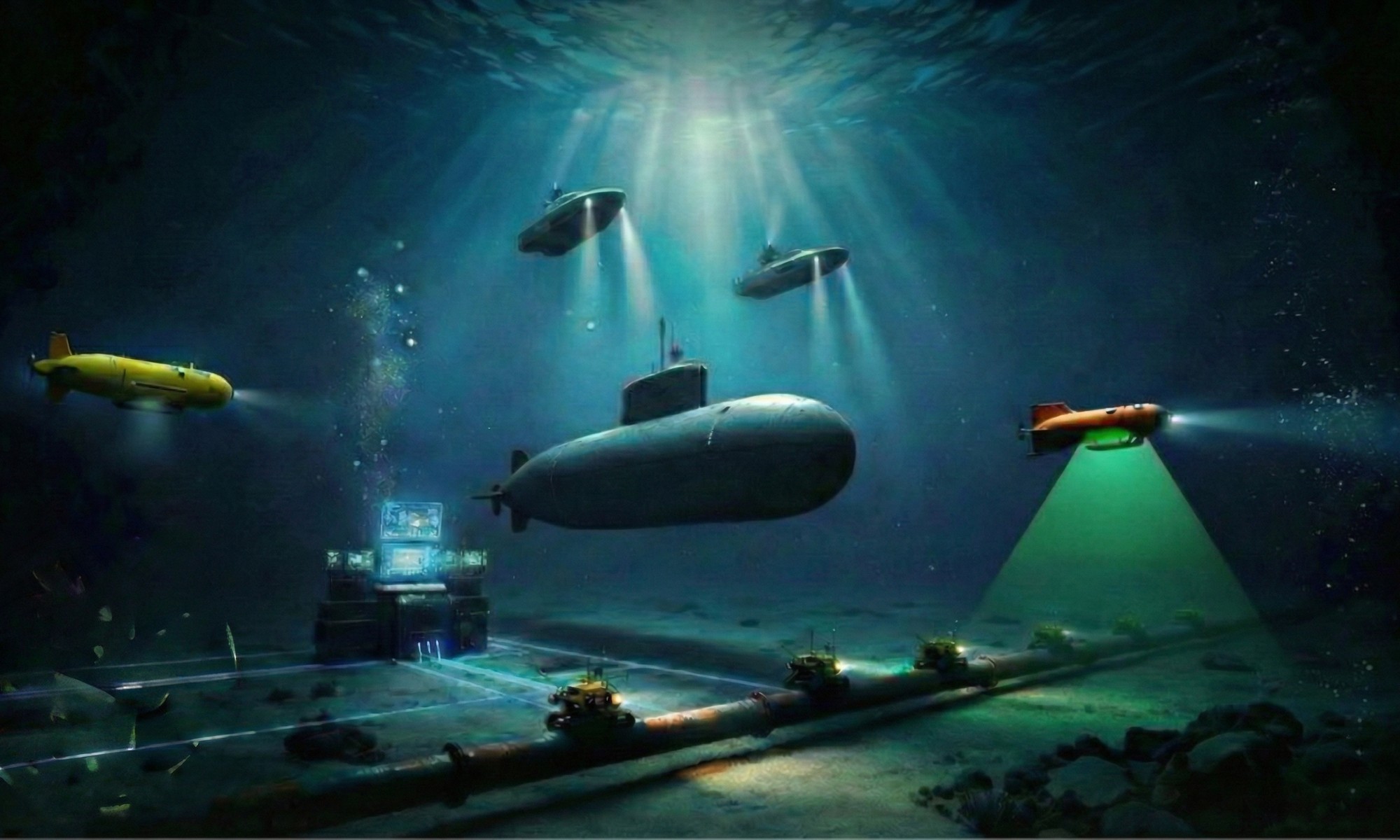
SeaGuard™ addresses this shift through persistent undersea awareness, protecting High-Value Assets and Critical Undersea Infrastructure from subsurface threats. Ships visit. Aircraft pass overhead. Human observers blink. A distributed acoustic system keeps listening.
The strategic reality rests on three pillars:
- Maritime power is subsurface power. Commanding the surface means little if the water column and seabed remain a black hole of intelligence.
- Environmental resilience is operational security. Reducing the sonic fog created by shipping, dredging, construction, and offshore industry is essential for clear acoustic channels and regulatory legitimacy.
- Technological dominance requires persistence. In a battlespace shaped by asymmetric stealth, 24/7 autonomous monitoring provides coverage that transient naval assets cannot replicate.
Surface control without subsurface awareness is an expensive illusion.
The Mahanian Blueprint, Updated
Alfred Thayer Mahan’s 1890 work, The Influence of Sea Power upon History, remains a powerful framework for maritime strategy. He argued that national influence depended on command of the sea: using the ocean for one’s own purposes while denying that freedom to an adversary.

We have traded sail for nuclear propulsion and signal flags for autonomous networks, but the logic remains intact.
Mahan identified six determinants of sea power: geography, physical conformation, territorial extent, population, national character, and government character. Chokepoints, harbors, industrial capacity, and political resolve still shape maritime power.
What changed is the depth of the contest. Seabed cables, offshore energy systems, autonomous vehicles, distributed sensors, and acoustic networks now belong in Mahan’s blueprint. Low-cost, high-endurance UUVs can threaten far more expensive platforms, while ports, cables, pipelines, and offshore facilities remain exposed.

The updated equation is simple: geography creates opportunity, industry creates capacity, government creates resolve, and undersea awareness prevents strategic blindness.
The Ocean Is Getting Noisier
The sea is filled with merchant traffic, seismic surveys, dredging, offshore construction, naval sonar, fishing activity, and biological sound.
For marine mammals, this noise can reduce communication range. For maritime operators, it can mask weak contacts and complicate classification. Try identifying a whisper beside a highway.
Noise can also delay permits, interrupt operations, damage reputations, and reduce sensor performance. Environmental monitoring and maritime security now share the same task: determine the source, location, movement, and meaning of underwater sound.
Persistence Beats the Perfect View
The Port of Miami deepening project demonstrates the limits of visual monitoring. Confined blasting required mitigation zones and protected-species watches. Aerial observers and boat teams helped, but visual systems remain vulnerable.
Darkness wins. Fog wins. Turbidity wins. Sea state often wins.
Acoustic monitoring extends awareness into the water column and beyond the human eye. It strengthens the watch and reduces the chance that important activity goes undetected. The same applies to port security: a patrol craft can inspect an area, while a persistent system can establish a pattern of life and keep watching after the patrol returns to the pier.
The SeaGuard™ Standard
The strategic frontier has shifted toward protecting Critical Undersea Infrastructure. Fiber-optic cables, energy pipelines, offshore installations, naval bases, and harbor approaches are exposed in a domain many security plans still monitor only intermittently.

Traditional patrols can deter and respond, but they cannot maintain continuous awareness throughout the water column. Ignoring the subsurface is leaving the front door open.
SeaGuard™ changes the model in three ways:
- Manufacturing excellence. Local production of advanced acoustic arrays supports supply-chain security and technical control.
- Persistent monitoring. Distributed acoustic coverage creates a continuous shield around High-Value Assets and helps identify UUV threats before they reach their objective.
- Full-spectrum protection. Autonomous processing, secure communications, and shore-based command functions connect historical maritime theory with modern robotic warfare.
What really makes SeaGuard unique is that it fulfills the complete equation:

Detecting a UUV beside the target is technically interesting. Detecting it far enough away to classify, track, and identify is operationally useful. But to complete the chain of Detection x Classification x Identification x Deterrence is the ultimate objective, in which most other systems fail.
Many nations still protect 21st-century infrastructure with 20th-century patrol concepts. Presence is not the same as awareness.
The Strategic Ping
The next maritime surprise may not arrive over the horizon. It may approach slowly, quietly, and several meters below the surface.
The winner will not necessarily own the largest fleet, which has been proven by Ukraine. It will be the force that detects earlier, classifies faster, understands context, and responds before a contact becomes a crisis.
Call to Action
Maritime leaders should ask one direct question: do we truly understand the acoustic environment around our most valuable assets, or are we hoping that a periodic patrol will notice the threat in time?
If your port, offshore facility, naval base, or subsea infrastructure still depends mainly on visual surveillance and occasional platform presence, reassess the defense model.
The water column is already contested. Start listening before someone else decides to test how deaf you are.
Originally published in the Strategic Pings ))) newsletter on LinkedIn on 2026-07-14. Subscribe there to get new editions first.