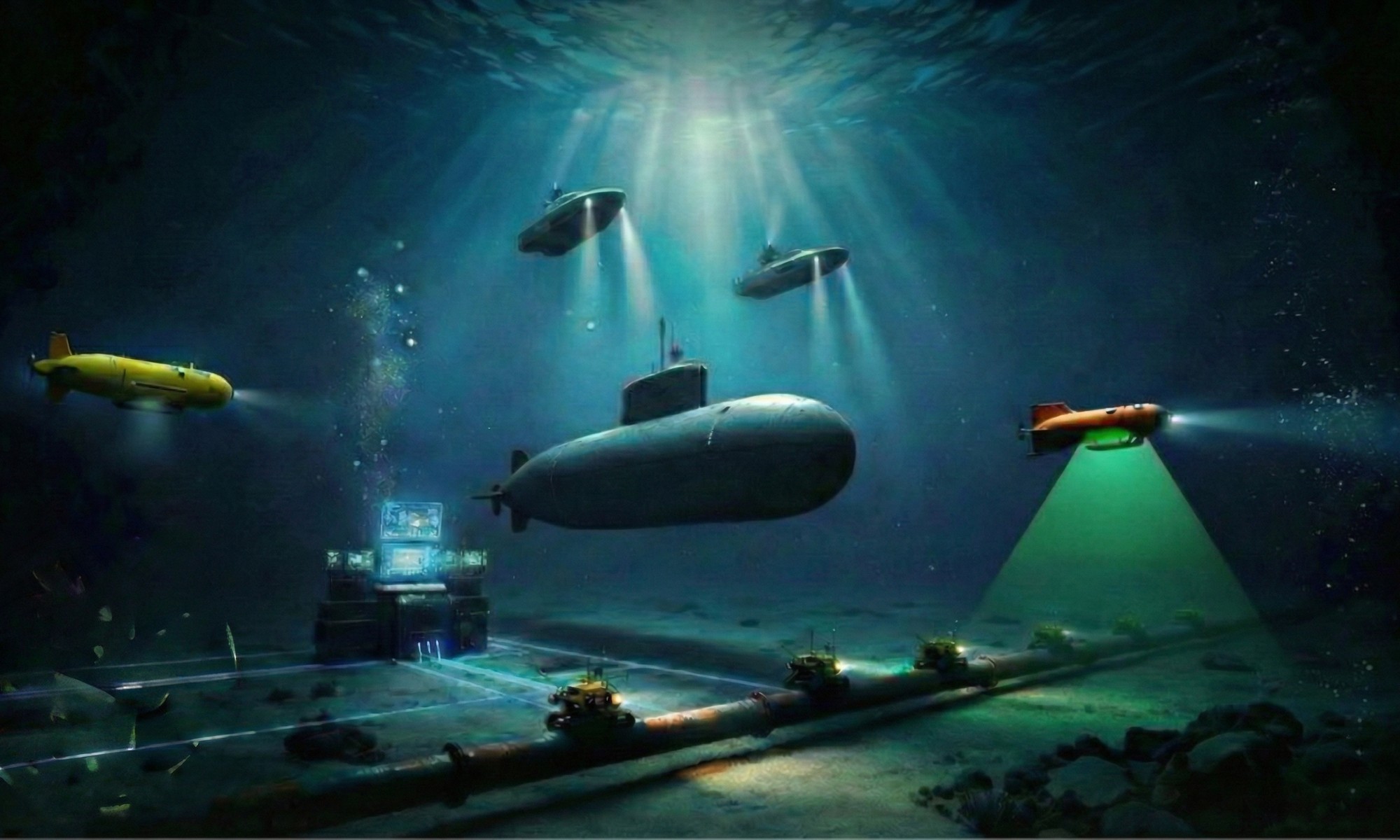

Mine Countermeasures (MCM) is entering a new era—one defined not by manned minehunters or clearance divers, but by autonomous sensor systems that keep sailors safely out of the minefield. Against a backdrop of rising geopolitical tension and repeated incidents involving subsea pipelines and communication cables, nations are embracing stand-off, unmanned MCM concepts at unprecedented speed.
Why the USV Matters, But Is Not the Capability

In this emerging operational model, the USV becomes the vehicle that carries the sensor suite, but not the sensor suite itself. This distinction is far more than academic—it is strategic.
Mines do not react to the design of the vessel. They react to proximity.
Removing humans from that proximity fundamentally reshapes the risk equation of mine warfare. Instead of sending a crewed minehunter into a suspected minefield, commanders now deploy an unmanned surface vehicle towing a sophisticated sonar package, operating autonomously, and maintaining precise navigation without exposing personnel to danger.
The USV provides the platform—speed, towing geometry, stability, and endurance. But the capability is the integrated sensor chain and autonomy stack.
The Modern MCM Mission Chain: Detect, Classify, Neutralize

The effectiveness of any MCM system depends entirely on the performance of its sensors and data-processing ecosystem.
1. Detection: Seeing the Seafloor in Centimeters
Modern detection relies on:
- High-frequency multibeam echosounders (MBES) to create a topography baseline
- Synthetic Aperture Sonar (SAS) delivering ultra-sharp seabed imagery (main sensor)
- High-SNR acoustic returns for cluttered environments
- Wide-area high-coverage geometries enabled by towed bodies or AUVs
Only centimeter-level imagery provides the confidence required to separate a mine from a rock, crate, anchor, or biological clutter.
2. Classification: Turning Raw Data Into Decisions
Classification now depends on:
- Machine learning
- Automatic Target Recognition (ATR)
- On-board and off-board processing pipelines
- Robust, low-noise navigation
- High-fidelity metadata and positioning
The shift toward AI-assisted classification dramatically reduces post-mission analysis time and increases throughput—critical in large minefields.
3. Neutralization: Precision Intervention
Once a contact is declared a mine-like object, neutralization requires:
- Precise localization
- Stable hover capability
- Deployment of expendables or ROV-based charges
- Autonomous reacquisition of the target
ROVs remain a critical component of the final step—machines dealing with the threat, humans commanding at a distance.
USVs as Host Platforms: The Global Shift
This operational logic is evident across major international MCM programmes. Consider:
- Textron’s UISS: A USV towing advanced minehunting sensors as part of the U.S. Navy’s LCS MCM mission package.
- Exail’s Inspector series: A modular platform capable of SAS towing, AUV launch, and multi-sensor operations.
- Thales/Royal Navy autonomous MCM trials: Demonstrating a scalable, distributed, unmanned delivery model.
- Belgium-Netherlands rMCM programme: Entirely built on the concept of unmanned off-board systems.
Across these programs, one consistent truth emerges: The boat is a host. The sensors are the capability. Autonomy is the glue that binds them together.
The Rise of Autonomy in MCM
Early USVs relied heavily on remote control. But autonomy is now evolving into a decisive operational advantage.
Human-in-the-loop → Human-on-the-loop — The system executes pre-defined patterns while an operator supervises rather than commands continuously.
Real-time autonomy decisions — The USV adjusts line spacing, towing behavior, or avoidance patterns based on conditions.
Intent-based autonomy (emerging) — An operator defines the outcome (“Search this area to STANAG confidence level”), and the USV decides how to execute—tow speed, pattern, sensor configuration, revisit logic.
This reduces workload, increases tempo, and standardizes mission execution across theatres and operators.
Why This Transformation Matters Strategically
The stakes have never been higher. Seabed infrastructure—pipelines, interconnectors, offshore wind farms, energy lines, and the fiber-optic cables carrying 97% of global internet traffic—has become a prime target for hybrid operations and grey-zone sabotage.
Autonomous MCM systems offer:
- Persistent presence without risk to personnel
- Scalable coverage across vast areas
- Lower cost per mission than traditional minehunters
- Distributed architectures resilient to attrition
- Rapid deployment in contested or denied environments
In the emerging underwater battlespace, autonomy and sensors—not hulls—define superiority.
The End of the Legacy Minehunter Era
For a century, sailors entered the minefield. Now, machines do.
The shift is irreversible. Modern navies will be defined not by the number of minehunters in service, but by their ability to deploy autonomous, sensor-driven MCM systems that find, classify, and neutralize threats at standoff distance.
In the new era of mine warfare, the vessels are unmanned, the sensing is autonomous, and the decisions remain human.
CLOSING THOUGHT
Modern MCM USVs mark the end of a 100-year paradigm
Sensors do the work
Autonomy handles the danger
Humans make the decisions
CTA (Call to Subscribe / Call to Action)
If you want more insights into autonomous systems, sonar technology, seabed security, and how modern navies are redefining MCM doctrine, subscribe to STRATEGIC PING, my LinkedIn newsletter on sonar technology, maritime autonomy and underwater warfare.
The next newsletter will focus on which sonar systems these MCM platforms use, so a comparison of SAS sonars, Kraken, THALES, EXAIL, and Northrup Grumman. Stay ahead of the curve. Stay informed and be part of the conversation.
Originally published in the Strategic Pings ))) newsletter on LinkedIn on 2025-12-29. Subscribe there to get new editions first.