
Executive Summary
Ukraine did not rewrite naval history by building a bigger navy. It did it by changing the math.
The Black Sea has become a live-fire classroom in modern sea denial. A country with a limited traditional fleet has forced a superior naval power to move, hide, disperse, and rethink how it operates. The lesson is brutal and simple: in contested waters, mass and tonnage no longer guarantee freedom of action.
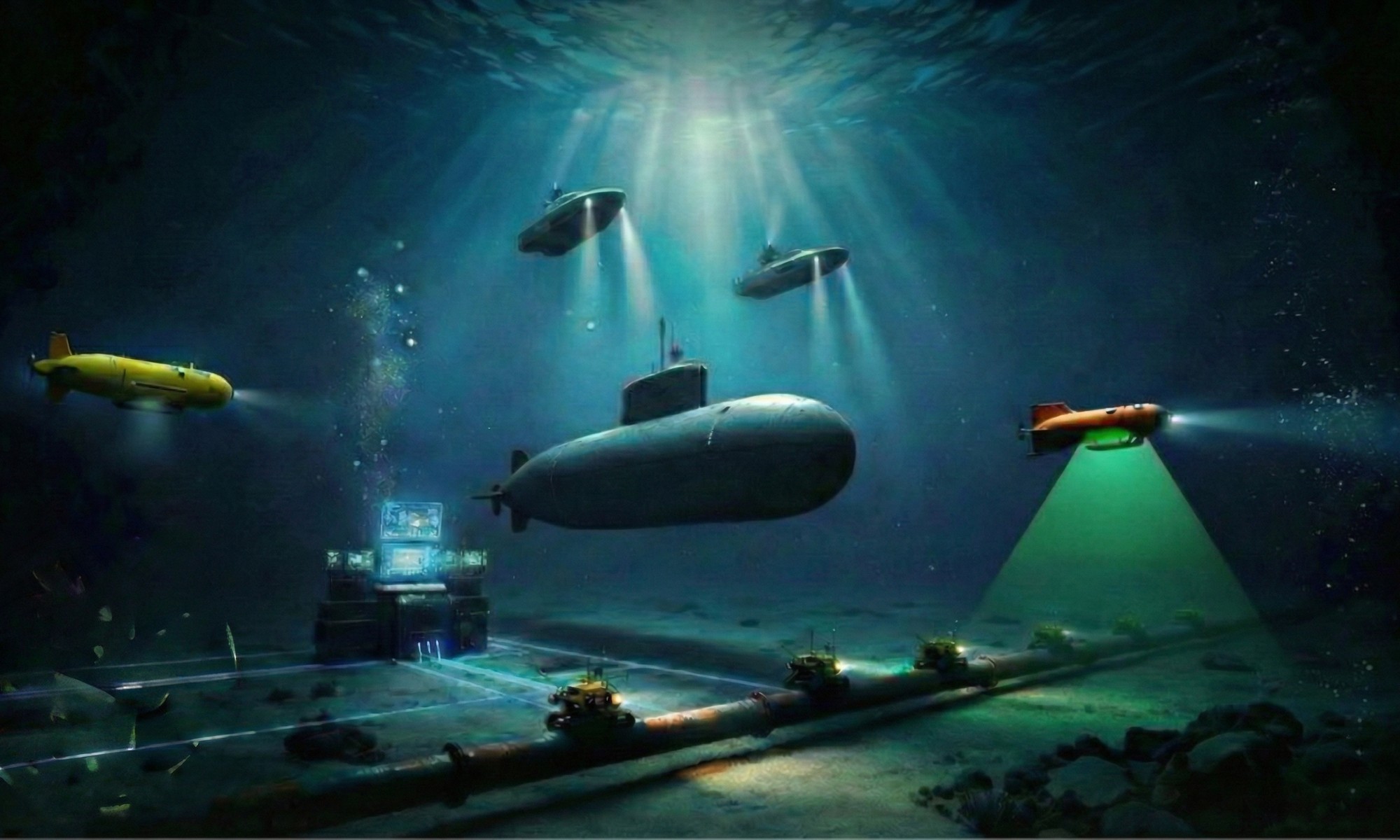
The first phase was about missiles and unmanned surface vessels. The second phase is now moving below the surface. With systems such as Sea Baby, Magura, Marichka, and the newly revealed Sea Trident heavy UUV, Ukraine is pushing the Drone Sea into a new domain. Surface drones made ports dangerous. Heavy underwater drones make distance, depth, and patience part of the kill chain.
This is where naval planners should start sweating. A long-range UUV with a heavy payload does not just threaten ships at sea. It threatens the places where ships feel safe: naval bases, anchorages, bridges, choke points, seabed infrastructure, and docked submarines.
The Drone Sea is no longer a coastal nuisance. It is becoming a strategic undersea problem.
Sea Denial Is Now the Main Event
For decades, navies have loved big numbers. Hull count. Displacement. Vertical launch cells. Carrier air wings. The bigger the spreadsheet, the more comfortable the briefing.
Ukraine made that spreadsheet look very old.
The sinking of Moskva and repeated attacks against Russian naval assets proved that a smaller maritime actor can deny space to a much larger fleet without matching it platform for platform. That distinction matters.
Sea control means you can use a maritime area and stop the enemy from using it. It is expensive, manpower-heavy, and difficult to sustain under persistent surveillance.
Sea denial is different. It says: “You may have the bigger navy, but you do not get to operate here freely.”
That is exactly what Ukraine has done in the western Black Sea. Russia’s fleet still exists, but its freedom of movement has been reduced. Ships have been pushed away from exposed locations. Operations have become more cautious. Ports are no longer sanctuaries.
That is sea denial doing its job.
The USV Became a Modular Fleet
The first naval drones looked like one-way attack craft. Fast, explosive, and expendable. Useful, yes. Sophisticated, not yet.
That phase did not last long.
Ukraine’s USVs evolved quickly from kamikaze boats into modular maritime platforms. Sea Baby, Magura V5, and other systems are now part of a broader unmanned fleet logic. They can carry explosive payloads, sensors, electronic warfare packages, mine warfare payloads, communications equipment, and even launch aerial drones.

This is the key point:
The USV is not the capability. The payload is the capability.
A USV with explosives is a strike weapon. A USV with antennas is an ISR node. A USV with jammers becomes an electronic warfare asset. A USV carrying mines becomes an attritable minelayer. A USV launching aerial drones becomes a small, ugly surprise for anyone who thought the maritime and air domains were neatly separated.
This is not traditional naval procurement. This is battlefield engineering at speed.
Front line feedback goes to the engineers. The engineers modify the design. The modified system returns to the fight. That short loop is more valuable than another glossy procurement roadmap.
If your acquisition cycle takes seven years and the enemy adapts in seven weeks, your process is not mature. It is fossilized.
Sea Trident Changes the Underwater Equation
Now the story moves below the surface.
The reported Sea Trident heavy UUV is not just another drone. It points toward a new class of long-range undersea sea denial. Reports describe Sea Trident as a heavy underwater system with up to a 1,000 kg payload and a range of up to 2,000 nautical miles. That is not a tactical toy. That is a strategic problem.

The tactical consequences are serious.
First, naval bases become more vulnerable. A long-range UUV does not need to attack a ship during a high-speed engagement. It can approach slowly, wait, and strike where defenses are weakest.
Second, ports and anchorages need to be defended in three dimensions. Surface barriers and cameras are not enough. Harbor defense must now think about seabed approaches, underwater loitering, acoustic signatures, and persistent underwater surveillance.
Third, bridges and maritime infrastructure become part of the target set. A heavy payload changes what can be threatened. It is not only about damaging a patrol boat. It is about threatening fixed infrastructure that supports military logistics and national resilience.
Fourth, submarines lose some of their sanctuary. A docked submarine, or one in a predictable operating area, becomes vulnerable to systems that do not need to behave like traditional torpedoes. The UUV can be patient. Patience is dangerous.
Fifth, mine warfare and strike warfare start to blur. A heavy UUV with range, autonomy, and payload begins to look like a mobile mine, a slow torpedo, and a covert strike platform at the same time.
That is a nasty combination.
The New Harbor Defense Problem
Traditional harbor defense was already hard. Divers, mines, small boats, sabotage teams, and underwater intruders were never easy to counter.
Now add long-range unmanned underwater vehicles.
The problem is no longer only “Can we stop a fast boat at the gate?” It becomes “Can we detect a quiet underwater vehicle before it reaches the pier, the bridge support, the cable landing site, or the submarine basin?”
That requires sonar coverage, seabed monitoring, underwater barriers, rapid classification, and response systems that can act before the UUV reaches the terminal phase, such as Sonardyne, Norbit or DSTL Intruder Detection Systems.
Detection alone is not enough. Understanding is the expensive part.
You need to know whether the contact is biological, environmental clutter, a drifting object, a friendly vehicle, or a hostile UUV with a heavy payload. That means better acoustic processing, better pattern recognition, and better response doctrine.
A false alarm every hour will paralyze the port. A missed contact can close it.
Drones as Maritime Police
There is another provocative branch of this story. Ukraine has also discussed using naval drones not only to destroy, but to stop and detain vessels.
That is a major shift.
A drone used for maritime policing needs more than a warhead. It needs identification, communications, escalation control, legal authority, non-lethal options, and probably aerial overwatch. It moves from kill chain to compliance chain.
This matters in grey-zone conflict. Sometimes the mission is not to sink the ship. Sometimes it is to stop illegal movement, enforce sanctions, document behavior, and force compliance without starting a larger war.
That gives smaller states more options. It also complicates life for anyone using commercial shipping as cover.
The VLS Trap Is Real
Russia is adapting too. That should not surprise anyone. Every weapon creates a countermeasure.
The larger lesson reaches far beyond the Black Sea. Western navies must solve the cost-exchange problem. A ship can fire expensive interceptors at cheap drones and win the immediate engagement, but still lose the campaign economics.
This is the VLS Trap.
Vertical Launch Systems are powerful, but they are finite. Once the cells are empty, the ship must leave the fight to reload. The adversary does not always need to sink the ship. Sometimes he only needs to drain the magazine.
That is why high-energy lasers, electronic warfare, decoys, guns, and layered low-cost defenses matter. The future defensive magazine cannot rely only on million-dollar interceptors.
In the drone age, cost per shot is not a detail. It is survival math.
Strategic Takeaway
Ukraine damaged more than ships. It damaged assumptions.
The Black Sea has shown that future naval power will be judged by speed of adaptation, payload modularity, sensor fusion, autonomy, and the ability to operate above, on, and below the surface as one connected system.
Sea Trident makes that lesson sharper. The Drone Sea is no longer only about explosive speedboats hitting ships at night. It is now about long-range underwater systems that can threaten infrastructure, bases, submarines, and logistics from unexpected directions.
The old fleet was built around platforms.
The new fleet is built around payloads and effects.
So the question for the maritime community is simple:
Are we still building 20th-century targets for 21st-century swarms, or are we finally designing fleets that can survive the Drone Sea?
Call-To-Action
Please comment, agree or disagree with me. We all need to learn from each other.
Originally published in the Strategic Pings ))) newsletter on LinkedIn on 2026-06-30. Subscribe there to get new editions first.