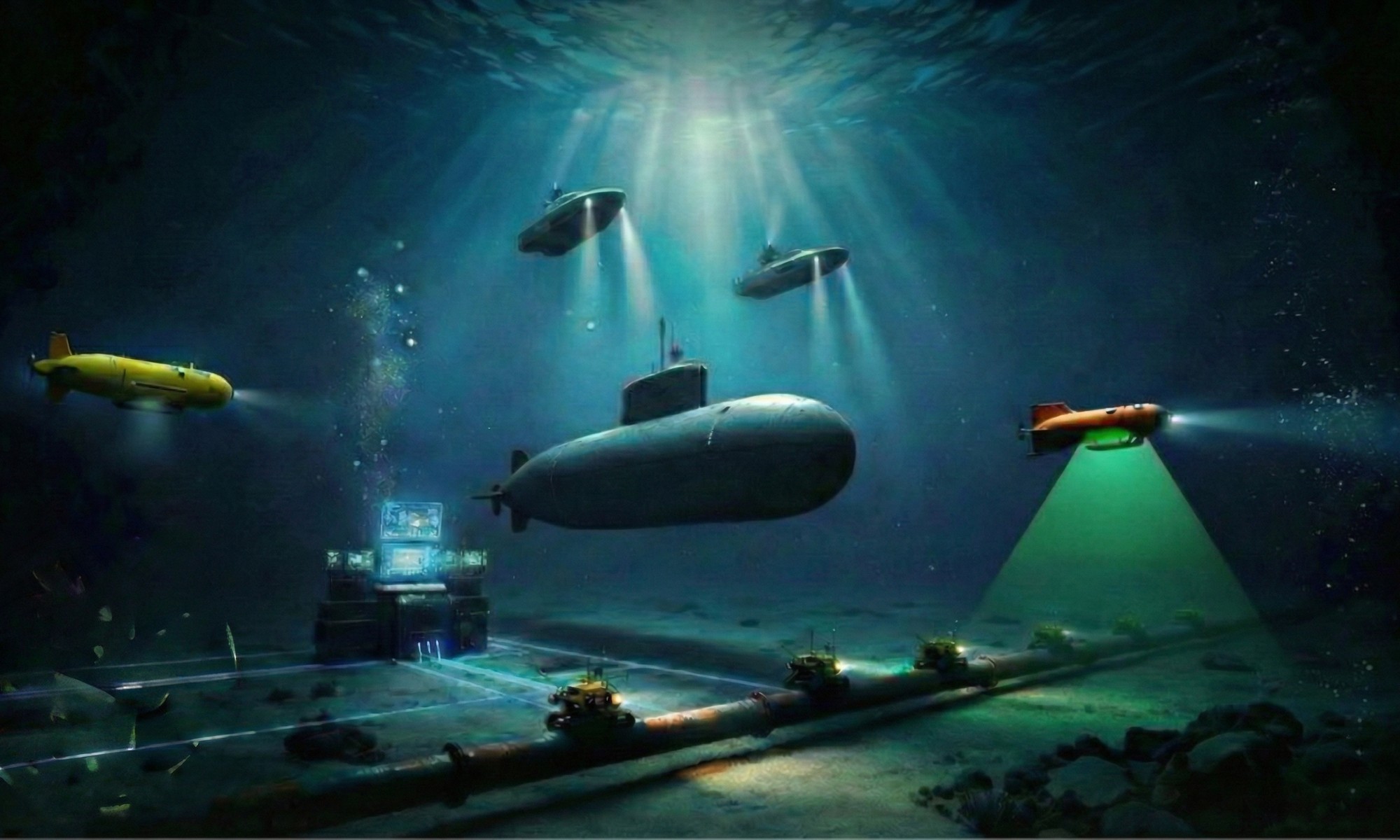

Shallow water is where submarines go to be clever… and where sonar engineers go to lose sleep.
Acoustics may be complicated in the open blue ocean, but at least the physics behaves predictably. In the littorals, Baltic-style basins, archipelagos, straits, coastal shelves, sound bounces off everything like a pinball machine with commitment issues: surface, bottom, rocks, wrecks, thermoclines that appear and disappear, and enough reverberation to make a choir sound like static.
Add dense traffic, biologics doing an interpretive dance on your spectrogram, and a seabed that changes from mud to cobble to granite in one coffee break… and you get the reality of littoral ASW.
I was fortunate to receive training from Professor Urick, who compared the Baltic with a portion of the South China Sea with respect to the hydroacoustic environment. Very complicated, he made one comment, “Avoid it if possible…”

Which is exactly why the strategic stakes are rising. Coastal waters aren’t just “nearby.” They’re gateways: ports, sea lines, chokepoints, and the corridors where critical infrastructure lives. If an adversary submarine can operate in your backyard, it’s not only hunting ships. It’s mapping patterns of life, sniffing undersea cables, and quietly rewriting your risk calculus. ASW in littoral and shallow coastal water relates to seabed warfare.
Here’s the uncomfortable truth: in littoral ASW, you have two valid ways to win.
You find the submarine.
You create deterrence, A2/AD, so submarines don’t dare to loiter in your operating box in the first place.
Those are not competing ideas. They’re a matched pair.
The Deterrence Frame: ASW as A2/AD, not just “search and maybe prosecute.”
A2/AD—Anti-Access / Area Denial, is the maritime equivalent of putting a “Keep Out” sign on the sea and then wiring the fence to the national grid.

Anti-Access (A2) is about stopping an opponent from getting into the fight. In ASW terms, that means controlling the gateways: straits, archipelagos, shelf breaks, and the transit routes submarines and their supporting forces depend on. If you can threaten the aircraft, ships, bases, and logistics that enable sustained ASW, you can keep the hunter outside the operating box—no presence, no search pattern, no persistence.
Area Denial (AD) assumes the opponent makes it in anyway and focuses on making operations slow, risky, and inefficient. This is where ASW becomes a layered trap: seabed sensors, USVs towing passive arrays, UUV patrols, mines, decoys, jamming, spoofing, and enough ambiguity in the acoustic environment to keep commanders awake. The goal is not always a dramatic kill. Often it is simpler: deny tempo, deny confidence, deny freedom of maneuver.
A2 keeps the door closed. AD turns the room into a maze of tripwires.
Now—where does multi-static USV ASW fit? Right in the sweet spot: it supports both. It can actively find submarines, and it can also help create the perception (and reality) that your shallow-water approaches are simply not comfortable to operate in.
That discomfort is deterrence.
The submarine’s favorite shallow-water playing card: Zero Doppler
Submarines don’t need to be truly invisible. They need to be hard to classify and hard to hold. In shallow water, the ocean gives them plenty of cover: boundary reverberation, multipath, shipping noise, biologics, and bottom clutter.
One of the most useful tactical tricks is Zero Doppler geometry.
If the submarine can maneuver so that its radial velocity relative to your active sonar geometry is near zero, Doppler cues get weak. Your discrimination suffers. Your tracker gets less confident. Your contact starts looking like “maybe something,” which is operationally deadly because “maybe” burns time—and in the littorals, time is what the submarine is stealing.
If Zero Doppler provides a strategic edge, the key question is: how can we remove that advantage?
The Multi-static answer: Geometry that the submarine can’t game
Monostatic active sonar (source and receiver on the same platform) is vulnerable to geometry games. A multi-static network is not.
In multi-static operations, you separate the source from multiple receivers distributed in space. A submarine can try to be zero Doppler to one receiver, but it cannot maintain zero Doppler to several receivers spread across different bearings and ranges at the same time. If it’s “boring” to one node, it will be moving relative to another. That means Doppler diversity returns to your side of the chessboard.
This isn’t a small technical upgrade. It’s a strategic shift: you deny the submarine control of the engagement geometry.
And that denial is exactly what AD is supposed to feel like.
The Multi-Static USV Swarm: One illuminator, many ears (and no single point of failure)
The clean basic CONOPS is a “1+4” USV formation:
1) Source USV (the illuminator)
One USV carries a high-power coherent source, typically 2–4 kHz for wide-area search in shallow basins. Coherent matters because the littorals punish lazy waveforms. You want control: multiple pings, variable durations, better processing gain, and the ability to adapt to a reverberation floor that changes by the hour.
Think controlled flashlight, not fireworks.
3–4 Receiver USVs (the listeners)
Three to four USVs tow passive towed arrays—digital, high dynamic range systems designed to capture high-fidelity snippets for fusion. These nodes stay acoustically passive, which helps survivability and reduces self-noise issues, while providing the geometry diversity that makes multi-static worth doing.
This architecture is also inherently resilient. Lose one node? The web degrades gracefully rather than going blind. That matters in contested littorals where attrition is not a hypothetical—it’s a planning assumption.
Shallow-water reality check: timing, navigation, and “ghost discipline”
Multi-static processing is unforgiving. If your timing is sloppy or your positions drift, you don’t get “slightly worse tracks.” You get false tracks. Ghosts. Expensive arguments.
This is why serious multi-static USV ASW needs:
- Tight clock discipline (microsecond-level timing),
- High-quality navigation fusion (INS + DVL + pressure, plus sanity checks), and
- Geometry control so your bi-static ellipses actually mean something.
Your system must keep behaving even when you have issues, because the submarine will not politely pause while you reboot your confidence.
Search Patterns: Don’t “swarm,” orchestrate
A swarm is a marketing word. Formation is an engineering word.
Receiver USVs should execute structured search patterns designed to maintain baseline spacing, angle diversity, and revisit rates that support tracking. A practical approach is coordinated “lawnmower” sweeps with controlled offsets, where:
- The source illuminates on a schedule,
- Receivers maintain geometry to maximize bistatic angle diversity,
- Network adapts spacing based on propagation and bathymetry.
The goal isn’t just detection. It’s hold. Hold is what enables deterrence, because a submarine that expects to be held behaves differently than a submarine that expects to slip away.
How this feeds A2/AD: Deterrence by Transparency
Here’s the strategic payoff:
A distributed multi-static USV field doesn’t just hunt submarines. It creates a perception—backed by physics—that your littoral approaches are becoming transparent.
That supports A2 by controlling gateways. Place these fields intelligently near straits, archipelagos, and shelf breaks, and you complicate transit planning. You force route deviations, slower speeds, and higher risk. You also threaten the supporting ecosystem, tenders, ISR assets, surface escorts, that submarines rely on for sustained operations.
And it supports AD by turning the operating area into a maze of tripwires. Even if the submarine enters, it cannot rely on its best stealth geometry. It cannot assume it can “go zero Doppler and disappear into clutter.” The web denies tempo and denies confidence—and a commander who lacks confidence becomes conservative.
That is deterrence in practice: not always a kill chain, often a decision chain.
Summary: Two ways to win, one architecture that supports both
Littoral ASW is not a single game. It’s two:
Find the submarine when it enters your operating box.
Prevent submarines from operating there comfortably through A2/AD deterrence.
A multi-static USV architecture, one coherent source USV and 3–4 receiver USVs towing passive arrays, supports both missions. It handles the shallow-water physics with spatial diversity, resilient geometry, and edge processing. And it delivers the strategic punch: it removes the submarine’s zero-Doppler playing card by forcing it to face multiple receivers at once.
A2 keeps the door closed. AD turns the room into a maze of tripwires. Multi-static USV ASW does something even better: it makes the submarine wonder if the room was ever safe to enter at all.
Call-To-Action
Please comment and share
Originally published in the Strategic Pings ))) newsletter on LinkedIn on 2026-02-17. Subscribe there to get new editions first.