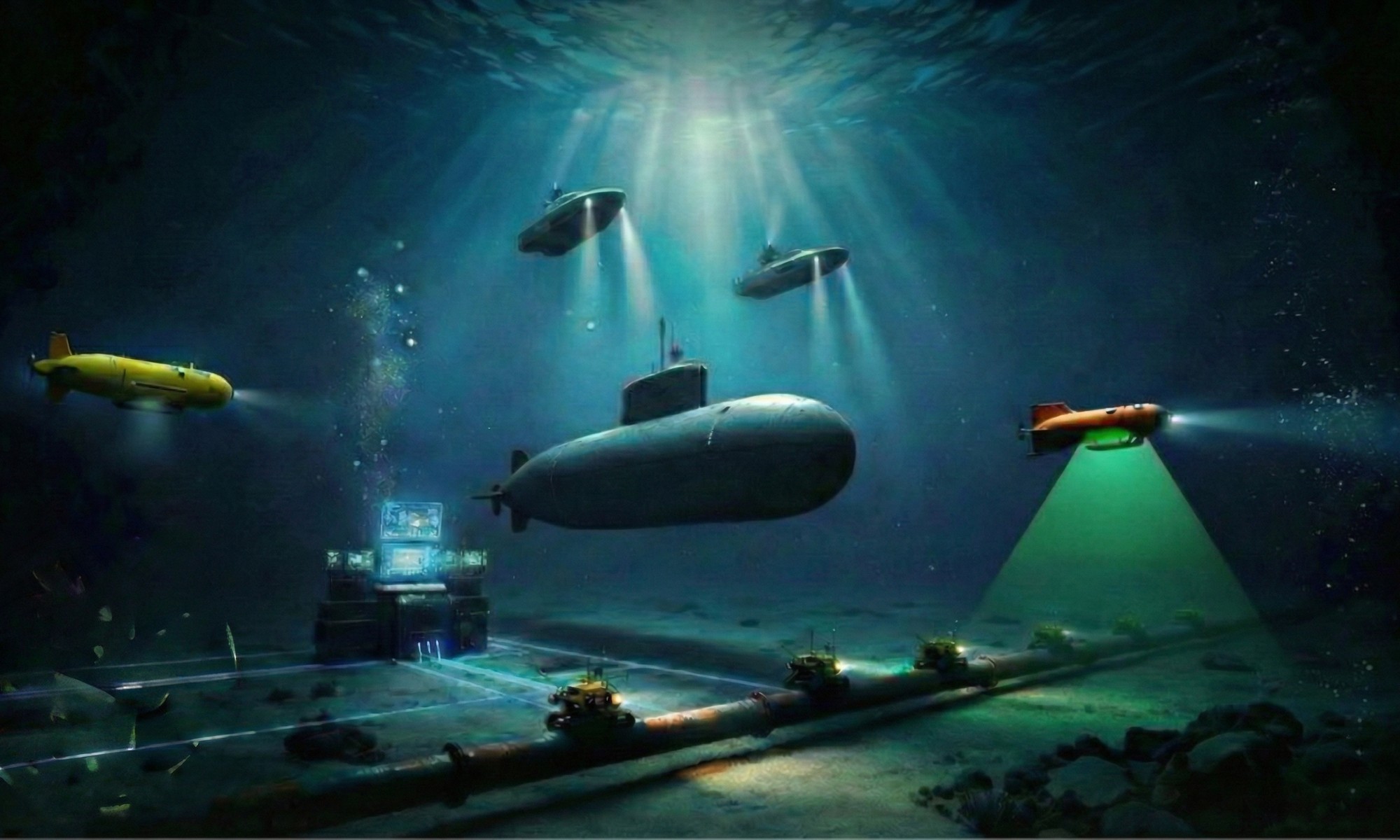

1. The Underwater Perimeter Has Moved
The waterline is no longer the boundary of maritime security. That line has sunk below the surface, into a domain that is opaque, cluttered, and unforgiving of delay.
Ports, naval bases, offshore energy assets, pipelines, and subsea infrastructure are now threatened primarily from below. Dive Detection Systems (DDS) have therefore become foundational elements of maritime protection architectures.

Yet despite significant advances in sonar performance, classification algorithms, and autonomy, most underwater security failures still stem from the same root cause:
Reaction time.
Detection alone does not stop an intrusion. Detection without timely action merely records it.
2. The Threat Has Changed Faster Than the Response Model
Historically, the underwater threat was human and constrained. Open-circuit divers produced bubble trails. Endurance was limited. Approaches were slow and predictable.
That era is over.
Today’s threat landscape includes:
- Closed-circuit rebreather divers with no visible bubble signature
- Widely available high-end commercial dive equipment
- Unmanned Underwater Vehicles (UUVs) with long endurance and zero risk to the operator
Complicating matters further, ambiguity is now routine. A sonar contact may be a saboteur, a recreational diver, or a survey drone. The sensor does not know. The command chain must decide.
And every second spent deciding compresses the remaining response window.
3. Detection Is a Solved Problem. Reaction Is Not.
Modern DDS sensors can detect small, slow targets in noisy, cluttered environments. The technical challenge of “seeing” underwater has largely been addressed, even if there are still issues with “false alarms”.
The operational challenge has not.
A credible dive detection architecture must support the full chain:
- Early detection
- Rapid classification
- Low-latency alerting
- Immediate, actionable response
If any part of that chain relies on slow human mobilization, the system fails operationally — even if it performs perfectly on paper.
4. Key Detection Systems and Their Strategic Roles
Forcys Sentinel
Forcys Sentinel is designed for long-range early warning. Its strength lies in coverage and standoff distance, detecting divers at significant ranges and UUVs even farther. There is also an interesting passive mode.
Strategically, Forcys Sentinel buys time. That time is critical for cueing mobile assets and initiating autonomous response actions before the intruder reaches the asset of interest. Sentinel performs best as the outer layer in a layered defense architecture.
DSIT AquaShield
AquaShield focuses on autonomy and discrimination. Advanced signal processing and adaptive thresholding reduce false alarms in busy harbors, which is operationally vital.
False alarms consume attention, degrade trust, and slow reaction. By delivering higher-confidence alerts, AquaShield accelerates decision-making and supports rapid escalation when required. Its hardened design also reflects an assumption that sensors themselves may be targeted.
SDIT also has the PointShield, a smaller portable sonar system.
Norbit GuardPoint
GuardPoint systems are optimized for persistent, fixed monitoring of critical infrastructure. Their value lies in continuous availability and reliability in known geometries such as ports and terminals.
As with all fixed systems, GuardPoint’s effectiveness depends on how quickly a response asset can be cued and dispatched. Integrated properly, it becomes a reliable sentry rather than a passive observer.
Norbit has several different sonar systems for intruder detection, all of which are named GuardPoint.

5. Why Human-Centric Response Fails
The moment an intruder is detected, the clock starts.
Traditional response concepts assume:
- An operator raises an alarm
- Personnel are notified and mobilized
- A patrol boat is crewed, started, and deployed
- The boat transits to the contact location
This sequence may take 20 to 60 minutes — sometimes longer.
For underwater intrusions, that is an eternity.
By the time a crewed vessel reaches the scene, the diver has exited, the UUV has completed its task, and the opportunity to act is gone.
This is why humans cannot be the first responders.
6. Automating the Response Loop
The only viable response model is a machine-speed reaction layer, centered on unmanned surface vehicles (USVs).
In this architecture, humans remain in command — but not in the pursuit loop.
The Operational Flow
Detection — A fixed or mobile DDS detects and tracks a subsurface contact.
Immediate Autonomous Dispatch — A pre-positioned USV is activated instantly. No crew. No delay.
Re-Detection and Close Classification — The USV intercepts the target and re-detects it using high-resolution, motion-stabilized sonar, maintaining continuous track despite sea state and maneuvering.
Evidence, Not Assumptions — The USV transmits sonar imagery, tracks, and behavioral data to the Commanding Officer via secure data link.
Command Decision at the Right Level — The CO receives verified classification, not raw alarms, and authorizes action while the intruder is still present.
This model preserves command authority while eliminating fatal latency.
7. Neutralization Options: Speed with Control
Once classification is confirmed, response options must already be integrated with the USV.
Typical actions include:
Physical Capture — Net systems launched from the USV to entangle divers or disable UUV propulsion. Clean, non-lethal, and legally straightforward.
Acoustic Disruption — Directional acoustic devices, including airgun-based systems, that create localized shock, vibration, or disorientation to deny mission completion.
Critically, these actions are executed from the unmanned platform, not after human arrival. The CO authorizes. The system acts.
8. The Strategic Takeaway
Dive detection is no longer a sonar problem. It is a time management problem.
The systems that matter are not those with the longest range or smallest detectable target, but those that compress the timeline from first acoustic return to decisive action.
If your response depends on waking people up, starting engines, and driving to the scene, you are already too late.
Underwater security is won by closing the loop, autonomously, quickly, and with command authority applied at the right moment.
In the subsea domain, reaction time is the weapon. Everything else is instrumentation.
Call-To-Action
Please provide comments and challenge me. We all need to discuss to learn more from each other.
Originally published in the Strategic Pings ))) newsletter on LinkedIn on 2026-02-02. Subscribe there to get new editions first.